“From Poison to Nectar: Bábá’s Transformative Response” & “Bábá’s Exemplar of Virtue into a day of active service and sentient protest”

“From Poison to Nectar: Bábá’s Transformative Response” & “Bábá’s Exemplar of Virtue into a day of active service and sentient protest”

Ácárya Gatimayánanda Avadhúta—CTS, GBTC

The term Niilakantha is a traditional Sanskrit name for Lord Shiva, meaning “The Blue-Throated One.” It originates from the mythological event where Shiva drank the poison (Halahala) that emerged from the churning of the ocean to save the universe, which turned His throat blue.

Spiritual Lessons: The blue throat serves as a powerful metaphor for handling life’s challenges. Just as Shiva held the poison in his throat, individuals are encouraged to manage their own negative emotions, stresses, and difficulties without letting them overwhelm their true nature.

  1. Environmental Symbolism: In contemporary times, the symbolism of Shiva drinking the poison is sometimes interpreted as a reflection on environmental issues, semipolitical wars, all-round degeneration, social injustice is the principal one. Just as Shiva absorbed the poison to save the world, there is a need for humanity to take responsibility for the environmental “poisons” we create, such as pollution and climate change.
  2. Meditation and Yoga: In the practice of yoga, the symbolism of the blue throat is often associated with the Vishuddha Chakra, or the throat chakra. This chakra is believed to govern communication and expression, and its purification is essential for spiritual growth. The blue color is often associated with this chakra, linking it directly to Shiva’s symbolism.

By naming the day “Niilakantha Divas,” Ánanda Márga followers are drawing a parallel between Bábá surviving the poisoning and the Shiva’s who consumes the world’s “poison” to protect others, though they specifically focus on Bábá’s instruction to return that “poison” with the “nectar” of service.

Instead of fasting, followers practice sentient anger against injustice. They counter malice with nectar by feeding the needy, proving that righteousness overcomes evil through service.

Rather than observing the occasion with fasting or sorrow, Bábá instructs His followers to manifest sentient anger by actively opposing injustice while responding to malice with benevolence.

The core ritual of the day is to counteract poison with nectar by providing the highest quality food to those in need, ensuring that even those without personal means participate through collective efforts.

Ultimately, the commemoration defines the day as a triumph of spirit over persecution, urging devotees to transform a historical act of cruelty into a widespread practice of generosity and social righteousness.

Niilakantha Divas commemorates the 1973 poisoning of Shrii Shrii Ánandamúrti in prison while Bábá was held in Bankipur Central Jail.

On the night of 12 February 1973, at approximately 11:30 pm or midnight, Bábá was administered poison in the form of a capsule.

The following morning, witnesses found Bábá lying on His bed, unable to move or speak. His eyes were red and watering profusely, and his brain and nervous system were not functioning properly.

While the authorities initially suppressed the incident, medical doctors—including Margi doctors—confirmed that these were clear physiological reactions to poisoning.

This event describes it as a conspiracy by the Central Investigation under then present government to eliminate Bábá.

The Central Investigation played an amidship and mastermind role in the poisoning of Shrii Shrii Anandamurti (Bábá) on 12 February 1973.

Hatching the Conspiracy to poison Bábá in Bankipur Central Jail was “hatched by some unknown central agency”. It was a Long-term Intent that the central agency “since very beginning” trying to “finish Bábá from this world”.

The poisoning incident is presented as a peak in their ongoing efforts to eliminate Bábá.

Government Collaboration and Suppression was that the Central Agency actions were linked to the then central government, which reportedly suppressed the incident.

When Bábá and the followers demanded a judicial inquiry to uncover the “black hands working from behind the curtain” and identify those responsible for the “nefarious work,” the government refused to grant it.

This refusal to investigate the central agency’s alleged role and the government’s suppression of the facts were the primary factors that compelled Bábá to begin His protest fast, which lasted over five years, 4 months and 1 day.

Despite writing several letters to the President of India to expose those working “behind the curtain,” the lack of legal recourse or official transparency led to a period of intense agitation where these acts of self-immolation occurred.

Self-immolation was undertaken by “Dadas and Didis” who were distressed by the government’s suppression of the truth as part of a wider agitation following the poisoning of Shrii Shrii Ánandamúrti (Bábá).

The unofficial Chakraborty Commission was established to investigate the events surrounding the night of 12 February 1973, after the government refused to institute a formal judicial inquiry into the matter.

The primary finding of the commission was a definitive confirmation that Shrii Shrii Ánandamúrti (Bábá) had indeed been administered poison while being held in Bankipur Central Jail.

The fast lasted for a total duration of five years, four months, and one day.

It provides the specific start and end dates and the exact duration of the fast, that it focus primarily on the 12 February 1979 discourse in Patna where Bábá clarified how followers should commemorate the date of His poisoning, rather than detailing the specific legal or political circumstances that led to the fast’s conclusion in August 1978.

The general history indicates that the conclusion of the fast coincided with Bábá’s release from prison after the charges against Bábá were overturned; however, it highlight the 1 August 1978 date as the point at which Bábá ended His long-term protest.

A clear timeline and the physical circumstances surrounding the beginning of the five-year fast, though we are not able to offer a granular hour-by-hour account of His daily routine.

The fast was not a voluntary spiritual practice but a compelled protest against the refusal of the then Central government to institute a judicial inquiry into His poisoning.

Despite the “nefarious work” of the Central investigating Agency, Bábá maintained this fast as a way to demand judicial proof.

Bábá’s specific daily activities, such as His liquid intake, sleep patterns, or how Bábá managed His spiritual or administrative duties from within the jail during those five years.

Bábá consumed only a small amount of liquid, such as curd water or lemon water, to sustain His body, so here the philosophical shift that occurred after the fast ended, where Bábá instructed that such periods should not be commemorated with personal fasting (which Bábá termed “tamasic”), but with “Amrit”—the act of feeding others and raising a sentient voice against injustice.

Transforming the Response through Niilakantha Divas to manage the long-term memory of the injustice, the Ánanda Márga Central decided to commemorate the date of the poisoning (12 February) as Niilakantha Divas. Over time, their response evolved from “tamasic” actions like personal fasting to a more constructive form of protest.

But Bábá instructed them to raise a “loud voice” against misconduct (anacara) and the “sinners” involved, rather than suffering in silence. Answering “Vish” (Poison) with “Amrit” (Nectar).

Instead of responding with bitterness or hunger, the Ánanda Márga cadres both family members and Whole timer Sannayasin was told to respond in a “subtler way” by performing acts of service. This involved feeding the needy the best possible food as a sentient reply to the poison that had been administered to Bábá.

By establishing their own commemorative traditions and focusing on social service, the community managed the absence of official justice by turning the event into a symbol of recoil and righteous action.

Shrii Shrii Anandamurti (Bábá) described the response of “Amrit” (nectar) to “Vish” (poison) as a “subtler way” of answering injustice. Instead of reacting with “tamasic” (static) or “rajasic” (mutative) anger, Bábá instructed His followers to use “sattvika krodha” (sentient anger) to counter the “nefarious work” of His poisoners.

Bábá explicitly questioned why followers would choose to fast on this day, stating it was not a day for hunger but a day to voice opposition against misconduct. Bábá told His followers to “eat well” and use their energy to protest against “anacara” (misconduct). To answer the “poison” Bábá was given, Bábá directed that every follower or family should, according to their capacity, feed the “best possible food” to at least one needy or deserving person.

If a family had five members, they were encouraged to feed at least five (or more) people. This instruction applied to everyone, including Avadhuta’s, Ácárya’s, and full-time workers who have no personal property.

Bábá specified that they should collect alms or raise funds specifically to buy food and feed others, ensuring the “Amrit” of service was distributed regardless of one’s own financial status. The essence of the “Amrit” response was to provide a positive, sentient alternative to the harmful act of poisoning.

While the “Vish” represented the conspiracy to “finish Bábá from this world,” the “Amrit” represented the spiritual Ánanda Márga members commitment to service and righteousness.

By giving “Amrit” in response to “Vish,” Bábá transformed a day of tragedy into a day of active service and sentient protest, where the reply to a grave sin was the performance of a virtuous deed.

ÁNANDA VÁŃII – History bears testimony that whenever a person states the absolute truth in any sphere of life, whether it be spiritual, social, economic or otherwise; sought clarification of doubts or protested against injustice and wrongs, the evil forces forthwith plotted against the person, administered poison, slandered and assaulted that person with rage, misused authority and mercilessly dealt blow after blow; but the blows boomeranged and ultimately the evil forces were annihilated by those very blows. Remember, by an unalterable decree of history, the evil forces are destined to meet their final doom. – 1 January 1974

The Genesis of Renaissance Universal – A Vision for Global Unity, Spiritual Humanism and Intellectual Awakening.

UNFETTERED VISION OF GLOBAL IMPACT ON HUMAN POTENTIAL AFTER  68 YEARS ON THE SKYLINE GENESIS OF RENAISSANCE UNIVERSAL
compiled from different sources by Acarya Gatimayananda Avadhuta

FORMATION OF THE DEPARTMENT OF RENAISSANCE UNIVERSAL

In 1958, Shrii Shrii Ánandamúrti established the Department of Renaissance Universal the core concept of universalism has been a cornerstone of Ánanda Márga’s philosophy, emphasizing the inherent universal nature of human beings. As the organization expanded, questions arose regarding the use of the word “universal” in the names of its subsidiary organizations.

Shrii Shrii Ánandamúrti, the founder of Ánanda Márga, addressed these concerns, highlighting the importance of adopting a universal outlook.
The Significance of Universalism, in His discourse, Shrii Shrii Ánandamúrti explained that human longing is limitless, and this desire is a fundamental characteristic of individuals across the universe. The spiritual path, or Dharma, is the means to quench this thirst for limitlessness. As such, Dharma is universal, and every human being is essentially a universal being.
Breaking Down Barriers, Shrii Shrii Ánandamúrti emphasized the need to transcend narrow feelings, such as caste sentiment, provincialism, and nationalism, which hinder spiritual growth.

Bábá demonstrated this through a profound experience with a devotee, Shivlal Yadav, illustrating the transformative power of spiritual awakening about Universal Identity. Then Bábá reiterated that human beings are fundamentally universal beings, bound together by the thread of Dharma. This universal identity supersedes physical, mental, and cultural variations.

Human beings are inherently universal, with a limitless desire for growth and expansion. The spiritual path is common to all, transcending geographical and cultural boundaries. They transcend narrow feelings of Caste, provincialism, and nationalism which are obstacles to spiritual growth and universal understanding.

In light of these generalization, the Department of Renaissance Universal is established to promote universal values, adoptive global unity, and facilitate spiritual growth. This department will:

1. Promote Universal Education: Disseminate knowledge on universal principles, spirituality, and human values.
2. Adoptive Global Understanding: Encourage dialogue and cooperation among diverse cultures and communities.
3. Support Spiritual Growth: Provide resources and guidance for individuals seeking spiritual development.

The Department of Renaissance Universal embodies Ánanda Márga’s commitment to universalism, aiming to inspire a global movement towards spiritual growth, unity, and limitless expansion

which was started on the 25th and the 26th of January 1958.

A DMC was held in Trimohan, the village where Devotee Narasingh lived, about 20 km east of Bhagalpur.

It was the first time a DMC was being held for two days in a row.

With Bábá’s permission Pranay invited Manas Ranjan Sarkar, who was initiated by Pranay in August 1956. He was younger brother of Bábá, who wanted to attend the DMC. Nearly 18 months passed without Manas realising who the Guru of Ánanda Marga was. So Manas Ranjan Sarkar was eager to see the Marga Bandhu, Gurudeva of Ánanda Marga and was told that he would be able to see at the DMC. Together with some Margiis from Jamalpur, Manas Ranjan Sarkar left for the DMC with feelings of great anticipation in his heart. As Manas only realized that his elder brother was an important person in Ánanda Márga.
After a half day office, in the afternoon of Saturday the 25th of January, Bábá set off from Jamalpur for Ekchari Railway Station near Trimohan by train. But before attending any DMC outside Jamalpur, Baba would always seek mother Abharani’s permission to attend it. For her part, Abharani would always approve Baba’s request.

Trimohan is situated near the confluence of the tiny river Kowa and the river Ganges.

On arrival Bábá summoned Harindra, Aniruddha’s younger brother, and his cousin Ramkumar and directed them to quickly script a drama depicting the social issue on widow remarriage and evils of the dowry. As they were unprepared for such a request, Bábá had to guide them and provided several satirical tips for the drama. It was hasty preparation but it was for the first time a social event had been staged at the Marga’s spiritual gathering.

Bábá also enjoyed the drama from the window of His room on the second floor of Margii Narasingh’s house where Bábá was accommodated.

Shortly after the drama ended, it was announced that Bábá would soon be addressing the gathering. The announcement was followed by a resounding chorus of ‘Parama Pita Bábá Ki, Jai’ from the expectant crowd waiting for Bábá to arrive.

Manas was sitting in the front row with some senior Margis, who on Pranay’s instruction were keeping an eye on him. As Bábá stepped into the hall, Manas craned his neck, eager to have a glimpse of the Marga Bandhu Gurudeva. When he saw only his Dada (his brother) walking towards the stage accompanied by Pranay and Narasingh, he asked the Margii seated next to him, “Where is the Gurudeva, Bábá Ánandamúrti?”

“Don’t you see the person in dhoti and kurta accompanied by the general secretary, Pranayda? He is the Gurudeva Bábá.”

When he heard that his brother(Dada) was indeed the mysterious Guru of Ananda Marga, Manas became highly emotional and let out a piercing shriek. Overwhelmed by the discovery, he fell into a state of ecstasy. Not knowing what had happened to Manas Ranjan, Sukumar Bose, who had been keeping a close watch on him, reported his abnormal condition to Bábá. Bábá replied that there was nothing to worry about and assured him that Manas would recover in due course. Bábá instructed that Manas should be left alone.

After a few devotional songs Bábá started His discourse, “Parama Puruśa, the Supreme Consciousness, is my Father; Parama Prakrti, the Supreme Operative Principle, is my Mother and the Universe is my homeland. We are all citizens of this Universe.”

Bábá supported his assertion by explaining the relationship of every human being with the rest of creation and with the Creator….The Margis gathered in that small village of Trimohan were very surprised to hear Bábá speak on a subject other than spirituality.

While those who had the opportunity for closer interaction with Bábá were aware of revolutionary ideas on a wide range of social issues, but this was the first time they heard Bábá speak specifically on economic issues. No one in that gathering could even remotely imagine that the revolutionary ideas.

Bábá expressed that day were the precursor to an all-encompassing socio-economic and political philosophy based on a universal outlook that Bábá would later expound.

Indeed, in the very first line of Bábá’s discourse in Trimohan, Bábá had introduced the essence of economic theory. That line became the cornerstone of the social philosophy Bábá began to propound more than a year later.

The next day during morning walk, Bábá further clarified what Bábá had said the previous night. As Bábá walked along the banks of the river Ganges with some local Margis, Bábá suddenly stopped and turned to the Margis who were struggling to keep up with Him.

Bábá asked, “Did you all follow My discourse last night?”

“Yes Bábá, a little,” one of them replied.

“You see, what can a human being do?

Human beings cannot create anything original. They cannot create the five fundamental factors that the universe is composed of.

All they are capable of doing is to make physical mixtures and chemical compounds from what has already been created by Parama Puruśa, the Supreme Father. Supreme Father has created the entire universe, all the innumerable galaxies, stars and planets. HE created this planet and made it suitable for all creatures to live on thousands of millions of years before human beings arrival.

But if a few individuals, who have come on this planet for only a short period, try to assert, ‘We are the owners of this physical world, is there anything more foolish than that? It is nothing but the height of ignorance and arrogance. They are blinded by self-interest.”

Slightly raising His voice, Bábá stated emphatically, “Sooner or later, everyone will have to accept that not only this planet but also the entire universe is the collective patrimony of all living beings and not of the human race alone. It is absolutely essential to build a society based on this concept if living beings are to survive on this earth.”
To the Margiis walking with Him who were struggling to imbibe His new ideas, it sounded like a prophetic declaration.
During the morning gathering of the 26th, Bábá announced the formation of a new departmental section of AMPS organization, called Renaissance Universal (RU).

It was first subsidiary wing of Ánanda Márga to be established, and its main objective was to provide a platform for intellectuals to discuss the diverse issues facing society, suggest solutions and create a new awakening in society.
After discourse Bábá convened a special meeting of the educated Margiis, youths and students.

Bábá told them that in order to revitalize society, it was imperative to bring about an Intellectual awakening amongst the educated people, the youth and the students, and to urge them to take on the responsibility of promoting progressive thinking amongst the general populace.

Bábá said that the main duty of the Renaissance Universal movement was to liberate educated people, the youth and the students from the shackles of the various dogmas that plagued society and to inculcate in them the ability to think logically and rationally.

Bábá declared that the higher social and human values had been corroded by dogmas, and that their absence had created selfishness, narrowness and hatred between people. Blinded by dogma, they were destroying each other, other living beings and the environment and ultimately becoming the cause of their own annihilation. Hence the struggle against all kinds of disparities.

Each and every member of society should enjoy equal rights as members of the same family, but at present their is a glaring disparity, and it is the duty of the Renaissance movement to dispel that disparity and bring about equality amongst human beings.

Society should have co-operative leadership, not subordinated leadership.

The Renaissance people will have to immediately start a movement to fight against all these disparities; for example, if 50% of the population who are women are remain downtrodden, how can there be all-round progress?

So these are the social duties, the social responsibilities of the Renaissance movement. The Renaissance people will have to wage war against these disparities, these inequalities; they will have to be rooted out of society.”

The events during the Trimohan DMC and following it were indeed a revelation of sorts to the Margiis. It slowly dawned on some of the more educated Margiis present at the DMC that Bábá intended Ánanda Márga to be far more than just another conventional organization propagating spiritual philosophy, social reform and meditation. They realised that through His teaching, Bábá was creating a blueprint to restructure all aspects of social society.

One day during His Field Walk in Jamalpur, shortly after the Trimohan DMC Bábá spoke about the defects of communism and capitalism.

“Capitalism is a defective philosophy based on one or other of these ideologies.

Pranay was the first to voice his opinion, “Bábá, both communism and capitalism are extremely powerful forces.”

Pranay, no forces on earth, no matter how powerful, can prevent the demise of communism and capitalism.

As it is the inexorable decree of Parama Puruśa, it is sure to happen.”

“Will they both disappear at the same time?” enquired Pranay.
“No, communism will be the first to go. It will be wiped off the face of this earth.

Capitalism will also disappear some time later, leaving no trace.”

Harisadhan commented in a mildly ambitious tone.

“Bábá, what is happening is just the opposite of what Bábá you are saying. Communism is spreading all over the world.”
“Wait for a few more years. It will disappear before your very eyes, “replied Bábá.

A few days later Bábá told Kishun Singh that communist rule would disappear first from the European countries and then gradually from China. It would take some time for it to be rooted out of China, but it was sure to happen.

During Bábá’s darshan the following Sunday, the 2nd of February 1958, Bábá announced the formation of the Renaissance Artists and Writers Association(RAWA), saying that it would be an adjunct to Renaissance Universal and that its purpose would be to infuse new life into literature and the arts.

It had five sub-sections covering the most important of the fine arts; the Artists and Painters Association, the Dramatists and Cinema-Artists Association, the Musicians and Dancers Association, the Writers Association and the Journalists Association.

About a year earlier, on the 14th of February 1957, Bábá had started dictating on a topic entitled ‘The Practice of Art and Literature.’ It was a long treatise in which Bábá explained the real objective of literature. Literature is not the portray of the superficial side of social life, nor is it the colourful spell of fantasy.

Rather it is the portrait of real life, an expression of the internal workings of the mind, a bold and powerful expression suppressed sighs of the human heart.

In order to preserve the sanctity and prestige of the name, literature must reflect the dynamic currents of society.

“The word sahitya, loosely translated as literature, can be interpreted as sa+ hita = hitenasaha, ‘that which co-exists with hita (welfare]: Where there is no inner spirit of welfare, we cannot use the term sahitya.

“….. Literature is that which moves together with society and leads society towards true fulfilment and welfare by providing the inspiration to serve. The statement ‘Art for art’s sake’ is not acceptable; rather we should say, ‘Art for service and blessedness.”

Baba went on to discuss the social responsibility of an artist or writer. He discussed drama, poetry, short stories, children’s literature, painting and the other arts. He also introduced two new categories of literature – epochal, relating to a particular age, and then that leading to the transcendental realm.

…In this long treatise on art and literature, Baba emphasised that every artistic expression should always bear in mind that guiding the entire humanity towards the transcendental goal is the true purpose of any art form.

Bábá concluded with an ardent appeal to writers across the planet:
“Today not even the Pacific Ocean between Asia and America is difficult to cross. The people of Asia and America are touching each other’s minds and have learned to accept each other empathetically as their own.

Europe, Africa, Australia, Mercury, Jupiter, the stars, the comets, the constellations – none of them is alien to the other; none is distant from the other. Gradually everyone has begun to realise the vibration of the one Universal Mind.

“It is my firm conviction that the future of humanity is not dark. Every human being will reach that inextinguishable flame that is forever alight beyond the veil of the darkness of the present – and reach it they must. Those who carry the message of that effulgent light will be forever revered by all humanity. I see in the writers and artists of today the potential to become such memorable and venerable people, and that is why I hold them in high regard.”

Bábá devoted much time to translating His literary ideas into a tangible form that artists and littérateurs could use to inspire society towards higher ideals. In this way Bábá contributed immensely to the field of literature, philology, linguistics and music.

INAUGURATION OF RENAISSANCE UNIVERSAL

A Central Committee of Renaissance Universal(RU) was organized at the Trimohan Dharma Maha Cakra. The members were:
SHRII PRABHAT RANJAN SARKAR Chairman
Ram Tanuk Singh, Adv. Chief Secretary
Amulya Ratan Sarangi, I. A. S. Member
Prof. Indradev Gupta, Katihar Member
Prof. Raghunath Prasad, Gorakhpur Member
Devi Chand Sharma, Agr. scientist Member
Dharmendra Rao, Agricultural scientist Member
Miss Rama Asthana Member

It was decided to open RU clubs in various cities with regular monthly meetings, debates on solutions to various problems. Clubs were opened at different universities and colleges around the country. Meetings and symposiums were held in Delhi, Allahabad, Jaipur, Patna, Ranchi, Calcutta and other important cities. Cosmic Society, a bi¬monthly magazine, was also published giving direction and shape to the new movement.

SHRII P.R.SARKAR gave RU Discourses in most of the DMC’s as its Chairman. Every lecture was scholarly and purposeful. These lectures covered many topics about complex problems and their solutions. These discourses were compiled in the series “A Few Problems Solved”.
In the Inaugural speech at Trimohan, Bábá discussed many problems and solutions of the society. The speech was published as ” Problems of the Day”, a short book.

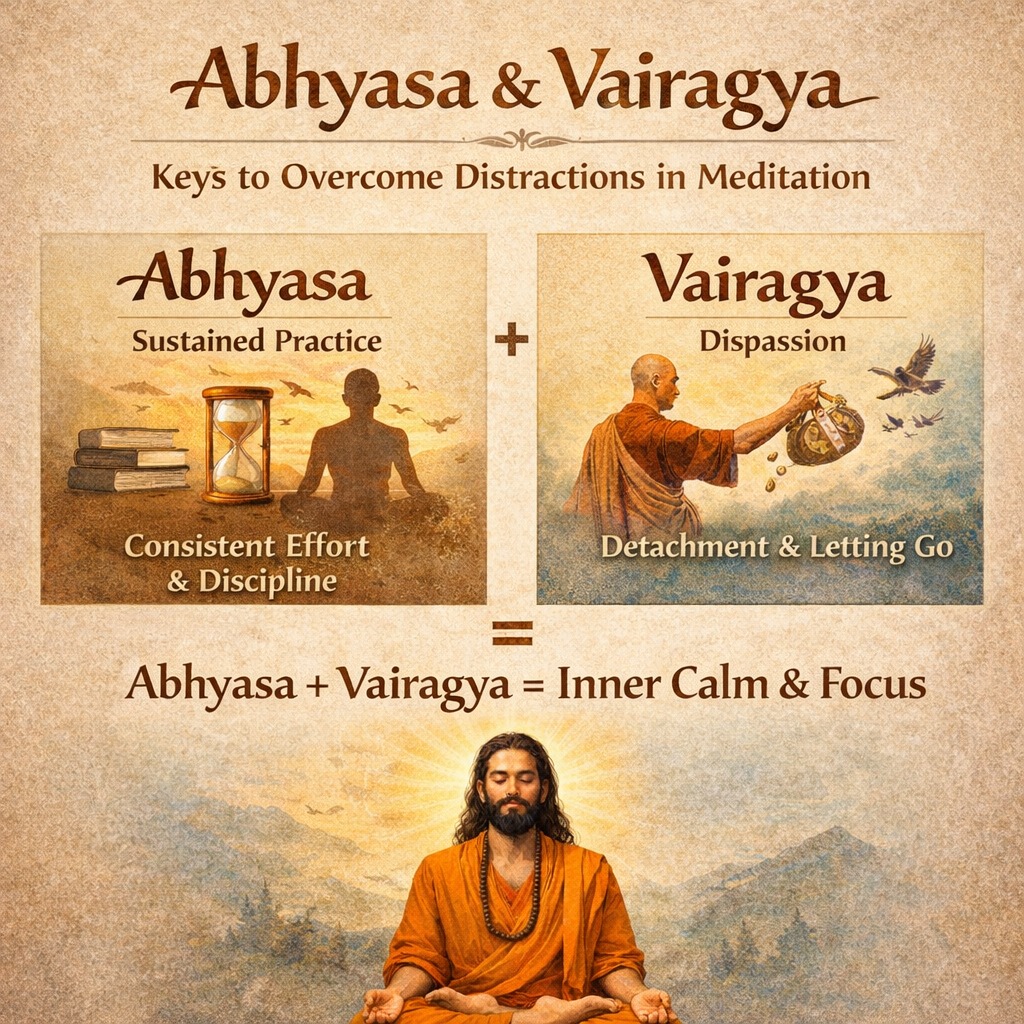
Abhyasa and Vaeragya are the key to overcoming the distractions during meditation

Every Sadhaka at certain point of his spiritual journey laments that he is unable to control the distractions of his mind despite his best efforts. He feels that the long hours of his sitting have landed him nowhere. In Bhagavad Giita, Arjuna laments:

Cancalam hi manah Krishna pramathi balavad dridham tasyaham nigraham manye vayor iva su-dushkaram

That is, the mind is restless, obstinate and very strong, O Krishna, and to control it, I think, is more difficult than controlling the wind. It is the case not only with Arjuna but with every Sadhaka. The distracted and fickle mind is always turbulent and creates upheavals for a Sadhaka.

The vacillations of the mind have been compared with a drunken monkey stung by a scorpion (Markatasya surapanam tato vrischika damshanam) in our scriptures. Many a time a spiritual aspirant wastes his time despite his long sitting in meditation as one or the other thought keeps bothering him. Replacing the worldly thoughts with the thoughts of God in his subconscious mind becomes a challenge. Then how to overcome this turbulence and achieve concentration in meditation? After all, Dhyana has to be like an unbroken or incessant flow (Tatra pratyaya ekatanata Dhyanam) for success. It ought to be like a smooth and continuous flow of oil (Taila-dharavat).

Lord Krishna suggests the following two remedies to tame the raging mind in Giita:

Asamśayam mahabaho mano durnigraham calam Abhyasena tu kaunteya vairagyena ca grhyate

That is “Arjuna undoubtedly, the mind is very elusive and difficult to control, but it can be controlled by sustained practice(abhyasa) and dispassion(vairagya).

By saying “Abhyasa vairagyabhyam tan nirodhah”, even Patanjali also endorses the same in his Yoga sutra. Patanjali emphasises the effort to be consistent, dedicated, prolonged and repeated one to achieve stillness. Vaeragya teaches us to be free from desire and aversion, helps us to give up things with impermanent nature.

But none of these can be achieved in a single day and there are also no shortcut methods to achieve it. Hence, Patanjali said that

“Sa tu diirgha kala nairantarya satkara sevito drudha bhumihi”

“This practice is firmly grounded only after it has been cultivated for a prolonged period, uninterruptedly and with an earnest devotion.”

However, one has to remember here that Abhyasa and Vaeragya are helpful only in overcoming the mental distractions, but they seldom help in the case of lack of concentration that arises due to health conditions such as thyroid problems, anaemia, chronic fatigue syndrome, migraines, hormonal changes, side effects of medication etc. These health conditions will lead to cognitive problems resulting in poor focus on the object of ideation. In such cases, one needs to consult a doctor.

ÁNANDA MÁRGA—A NEW SPIRITUAL ROUSING IN SOCIETY

ÁNANDA MÁRGA—A NEW SPIRITUAL ROUSING IN SOCIETY


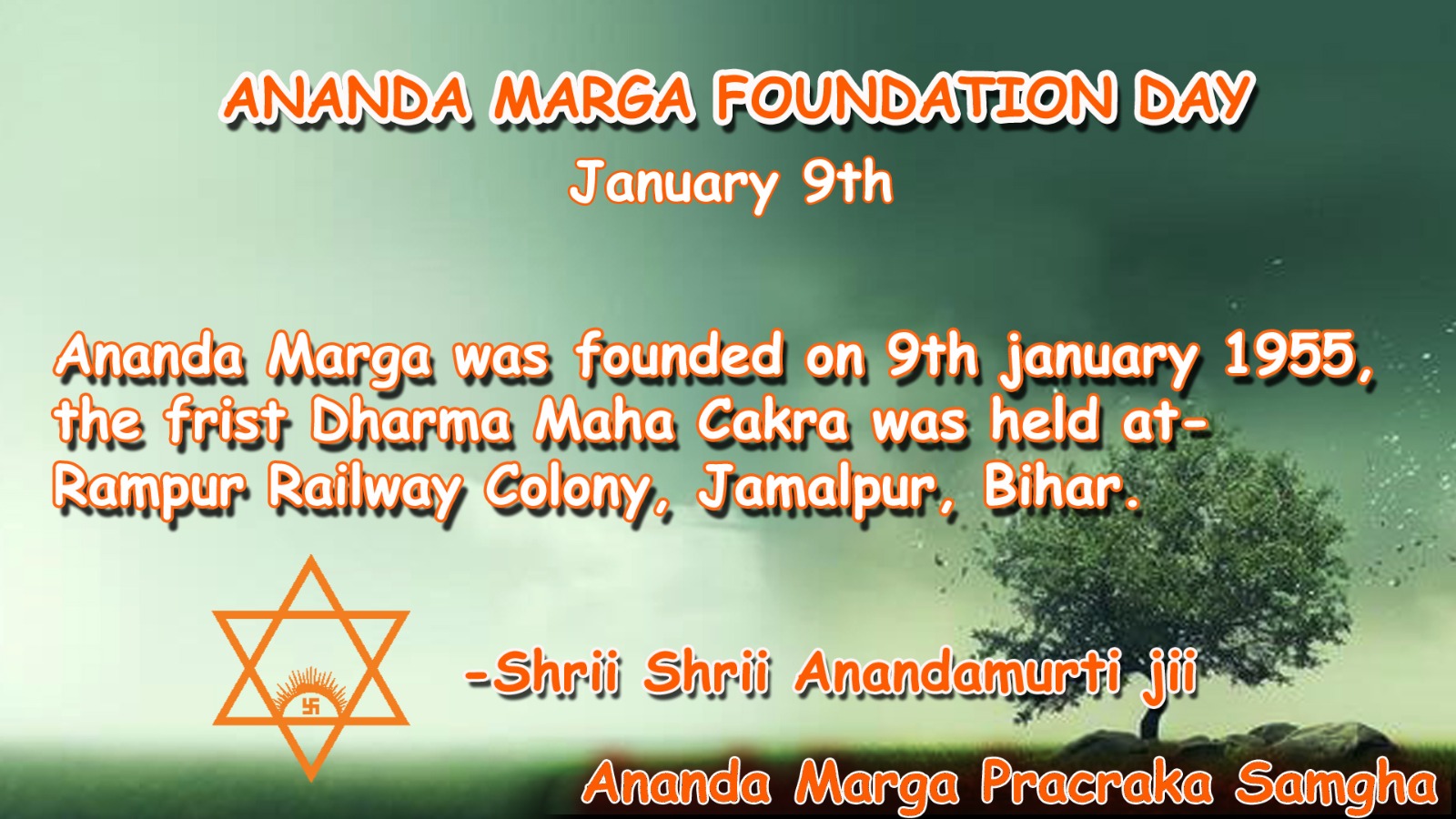
1955, FIRST DHARMA MAHA CAKRA
In the meanwhile, on Bábá’s instruction, Pranay and Shiva Shankar informed all the initiates that a gathering would be held at the railway quarters on the evening of the 1st of January 1955.

At the entrance, a cardboard sign was hanging bearing an instruction, “Smoking not permitted in the ashram premises”.

Those who had heard about the incident of 25th December did not fail to notice the significance of this.

Next to it was a second sign with a Sanskrit couplet: Shive ruśt́e gurustrátá gurao ruśt́ao na kashcana.

Many wondered about this and asked Pranay what it meant.

Pranay explained, “It means that if God (Taraka Brahma) is displeased with a spiritual aspirant, He can seek the shelter of the Guru (the manifestation of Taraka Brahma) to protect himself from the wrath of God.

But if the Guru is angry with a disciple for any reason, even God cannot protect him.

So one should always be alert to make sure one is following the instructions of the Guru.

Bábá guaranteed the other day that those who follow the directions of the Guru are under His complete protection at all times, and no harm whatsoever will come to them from any source, as there is no power in the universe greater than that of the Guru.

We should always remember that, truly speaking, the Guru and God are one and the same.

In the Guru we have an omniscient and omnipotent God as well as a Supreme Guide to help us at every step of our lives.”

Hearing Pranay’s explanation, the listeners had a new understanding about the importance of the Guru in one’s spiritual life.

INDUCTION OF ÁNANDA MÁRGA

Around sixty adherent devotees had gathered in the ashram, braving the chilly evening of the New Year’s Day.

Since the room could not accommodate so many people, an enclosure was erected in the open part of the compound to protect everyone from the cold.

For the first time ever some of the adherent devotees brought their wives along who had imparted by Diikśa.

Many people came for the first time, as they had heard about the amazing demonstrations Bábá had performed during the previous three gatherings in November. Just after dusk Bábá arrived.

Just after dusk Bábá arrived, accompanied by a couple of adherent devotees. Bábá took His seat on a cot in the verandah and greeted everyone first in Bengali and then in Hindi.

“I hope you are all in the best of spirits. I hope you are feeling blissful on this beautiful New Year evening.”

Everyone felt a perceptible change in the ambiance as Bábá took His seat and slowly gazed from left to right. A sublime atmosphere permeated the entire enclosure and a feeling of blissful tranquillity descended upon everyone.

Soon everyone felt that the severity of the cold had considerably abated.

Bábá spoke mainly in Hindi, occasionally interspersing His talk with Bengali, presumably for the benefit of some of the women who were not well versed in Hindi.

“We have all gathered here with a great mission, a lofty goal, and that is to bring about a new spiritual awakening in society based on a spiritual ideology. This awakening will usher in a new chapter in human history.

This spiritual Ideology I have named ‘Ánanda Márga’.

‘Ánanda’ means Infinite/Eternal bliss and ‘Márga’ means ‘the path’.

So the objective of this ideology is to impart a spiritual touch to every aspect of human life.

In order to spread the ideology we have decided to create an organization and call it Ánanda márga pracáraka saḿgha, Do you all approve of this name?” “Yes Bábá!”

Everyone voiced their approval in unison.

Bábá continued, “Everyone who is a follower of Ánanda Márga has two important missions in life.

That is Átmamokśártham and Jagaddhitáya ca.

Every one of you should sincerely carry out your spiritual practices for attaining the liberation of your mind and become one with the Supreme Entity.

The other aspect of life is that everybody has a responsibility to work for the welfare of society.

Here by society I do not mean only the society of human beings. As human beings are the most developed living beings, we all have a responsibility to work for the welfare of all beings, including the entire flora and fauna of the universe. Do you all understand? “Yes Bábá.”

“Very good. Alright. Pranay will give you further details. He has been given the responsibility of serving as the General Secretary of the organization. I hope you will all extend your full cooperation to him in running the organization and assisting in its growth.”

“Yes Bábá, we will”.

Everyone responded enthusiastically.

Bábá then began His discourse by explaining the gradual evolution of society, how it passes through different phases of the social cycle, and how in each phase a particular social class such as the warrior, intellectual, or business class dominate and exploit the others.

Bábá explained that if a particular class dominates society, it would certainly exploit the others. Before concluding the discourse Bábá gave a short summary of the primary purpose of the new organization:

ÁNANDA MÁRGA envisions a society without divisions or discrimination, where everyone will enjoy equal rights and opportunities. For humanity to progress, a harmonious social system is most essential.

Due to financial difficulties, how many meritorious students are forced to abandon their education and how many artists are compelled to suppress their talent before it is expressed?

This happens due to defects in the social order. Such a situation cannot be allowed to continue any longer. The system of division and discrimination is like the tightly woven nest of the weaver bird; it must be broken into pieces forever.

Only then will human beings be able to lead the entire human race along the path towards spiritual welfare. Until that happens, perhaps only a handful of people will be able to attain the pinnacle of spiritual glory, but it will be extremely difficult for all humanity to attain the supreme stance.

In a harmonious social order no one will run after fame or wealth like a mad dog. A congenial physical environment will help them to achieve mental balance, and, as a result, people’s psychic poverty will gradually decrease.

“O human beings, try to understand your human needs and build an appropriate social
system. Do not try to do anything for petty personal or group interests, because nothing done with a narrow outlook bereft of cosmic ideation will last.

The cruel hand of time will obliterate all your achievements and plunge them into an oblivion you cannot fathom.

It is not necessary to study books to know how to move, what to build, what to break, what to preserve. You should look upon every living being of this universe with sincere feelings of love and compassion. Only then will you realize that whatever you do, build or preserve already contained within and vibrated by the flow of the blissful Macrocosmic Entity.

Through action mixed with devotion and knowledge you will discover the life of your life, the supreme treasure of your inner being, that Supreme Entity, which you have unknowingly kept is hidden in the golden temple of your heart.

The disciples noted the significance of the fact that in this very first official function of the soon-to-be-founded organization, Bábá departed from his earlier practice of speaking on a purely spiritual subject.

Instead Bábá began by discussing the dominance of various classes in different phases of the social cycle and how this had led to the exploitation of the rest of elimination of inequality is a prerequisite for leading the entire human race along the path of society, as well as how to put a stop to endless social injustice.

Bábá stressed that the spiritual welfare. Even though ÁNANDA MÁRGA was still not officially formed, the devotees understood that Bábá’s ideas were not confined to spiritual matters alone, but also included radical and progressive thinking about the structure of society, economics, and other issues.

After the function was over, food was served to everyone. First, a plate of food was offered to Bábá. Bábá blessed it by touching it and asked for it to be shared by everyone.

Bábá announcement that on the evening of Sunday the 9th there would be a gathering of all the sadhakas, and an official declaration of the formation of ÁNANDA MÁRGA would be made. Bábá asked everyone to inform the other disciples who were not present.

Then Bábá got up and left for His usual Field Walk accompanied by Chandranath. Asthana, and a couple of others.

Before leaving the premises Bábá joked, “In one matter none of you should follow My example, and that is, like me, you should not leave without taking your food.

Though the devotees were only a few in number, they had become highly inspired by the positive effects of Sadhana/meditation in their own lives and overwhelmed by the extraordinary powers of their Guru.

So when Bábá announced the decision to establish an organization to spread spiritual ideals, it sparked tremendous excitement in them.

They felt that through the decision to create an organization to spread ÁNANDA MÁRGA’s ideals, Bábá had responded to their own internal urge.

It was remarkable how in a matter of only a few days they had identified themselves so intimately with Bábá’s teachings and the way of life prescribed. This created a close bond amongst the devotees and soon they started to identify themselves as Margiis.

THE GATHERING OF 9TH JANUARY, 1955
As announced by Bábá, a second organizational function was held on January 9th. The gathering had swelled to over eighty(80), so the enclosure that had been erected for the previous gathering had to be extended to accommodate everyone.

A simple cot was placed on the veranda with a cover spread over it.

A thin tarpaulin was spread over the grass for everyone to sit. Bábá spoke in immaculate classical Hindi, and everyone was fascinated not only by the topic but also by the beauty of His language.

One of the recurring themes of Indian philosophy is the relationship between Puruśa and Prakrti and the topic was “Prakrti Tattva and Oṋḿkára Tattva”.

In this second discourse about Ánanda Márga philosophy. Bábá explored the nature of Prakrti and the three principles that she is composed of the sentient, mutative, and static. The characteristics of the sentient principle are knowledge of one’s existence and imparting happiness and a sense of relief. The mutative principle is characterized by endless action designed to keep the “I” or “self” busy, and the characteristic of the static principle is to experience and enjoy the result of the action.”

In a flower, for example, the bud blossoms due to the action of the mutative principle. When the flower is in full bloom, this is the state when the sentient principle is active, and when it starts to wither, it is due to the action of the static principle.

In Indian philosophy Prakrti is traditionally considered to be synonymous with illusion or ma’ya’. This type of thinking has inevitably led to the development of a pessimistic outlook among the people of India.

Bábá explained that Tantra, on the other hand, regards Puruśa and Prakrti as one entity, like milk and its attribute of whiteness.

Depending on which of the three principles predominates in a person’s mind, it will have a specific color and correspondingly a different psychology. These mental colors have been wrongly described as either physical colors, as in the case of racism, or as representing different castes.

Bábá stressed that the goal of every Sa’dhaka was the absolute state of Consciousness beyond the influence of these principles.

Therefore, the followers of Ánanda Márga should not differentiate people according to caste or any other narrow consideration.

In His discourse Bábá used the word ‘devata’, meaning gods and goddesses in its feminine form. Dipanarayan, who was a postgraduate in Hindi literature, felt uneasy that while speaking such beautiful Hindi.

Bábá had committed the simple grammatical mistake of using the word ‘devata’ in a feminine form, as in Hindi ‘devata’ was considered a masculine term. Hardly had the thought crossed his mind when Bábá digressed from his subject of discourse and looking at Dipanarayan, said, “In Vedic Sanskrit, ‘devata’ is feminine in gender.”

Bábá then returned to his discourse. Dipanarayan was taken aback by such a fast response to his thought. He was surprised that even while discussing such a profound topic, Bábá was fully aware of what everyone was thinking.

In the course of his discourse, Bábá explained the significance of Oṋḿkára. Clearing up the general misconception that Oṋḿkára was a mantra to be chanted during meditation Bábá explained that it was the primordial sound of creation and not a mantra. In the process of liberating oneself from the principles of the Creative Force, every Sa’dhaka experiences this cosmic sound, the Oṋḿkára. Oṋḿkára encompasses the sentient, mutative, and static realms of creation as well as the realm of the pure Consciousness beyond.

As Bábá elucidated this concept, a few people in the audience heard the cosmic sound, as if it had wafted in from infinite space. They wondered what it was, as they had never heard it before. Bábá then recited some Sanskrit verses describing the glory of Oṋḿkára and explained its meaning:

“The supreme spiritual state, which all the scriptures have described, and for which Sa’dhaka’s have undergone much hardship and practised cosmic ideation lives altogether, can be described in one word by the word ‘Oṋḿ’. This is the state of the Supreme Entity. Knowing this Supreme Shelter, one becomes firmly established in the Supreme Consciousness.”

Bábá concluded by exhorting the disciples to make sincere efforts to elevate themselves towards divinity through their sadhana and devotion, saying that through sadhana and devotion they would be able to merge in the endless stream of divine effulgence. Bábá’s concluding words of His discourse touched the heart of the new initiates:

“From distant ages you have been moving towards the Supreme Beatitude. You have suffered untold privations, and today you have the greatest opportunity to become worthy human beings.”

After concluding His discourse Bábá paused for a while and then continued. “Some of you who have reached a certain level in your sadhana are now hearing the Oṋḿ sound. Soon the others too will hear this cosmic sound according to the stage of sadhana they have attained.

The primordial sound Oṋḿkára resonates through various chakras of the body as per the state of their sadhana and appears as different sounds. The initial sound is like that of the cricket. Slowly, as the mind rises through various chakras, it changes and becomes the sound of ankle bells, then the flute, the sound of waves of the ocean and then the gong. In the final stage of sadhana one hears the pure Oṋḿkára alone.”

In a short while everyone present heard one of these sounds in accordance with the stage of sadhana they had attained. As they became deeply absorbed in it, some went into a spiritual trance, uttering cries of “hum!” and “Bábá!”

Several minutes elapsed while they were immersed in the blissful, divine trance. Bábá then ended their meditation by intoning a Sanskrit mantra. When they opened their eyes, Bábá said. “These are the experiences that one can have as the kundalini rises through the various chakras. Later I will explain this topic in greater detail.”

Bábá then asked Shiva Shankar Banerjee to come forward and instructed him to sit erect and meditate. Bábá commanded Shiva Shankar’s kundalini to rise and pierce the chakras one by one. Initially Shiva Shankar’s body writhed like a snake. As his kundalini started to rise, his body slowly calmed down. As it reached the ajina chakra between the eyebrows, he fell backwards in a blissful trance and became motionless, while Bábá explained the various stages that one could experience as the kundalini rises through the chakras.

Finally, as Bábá ordered the kundalini to return to its normal position in the muladhara chakra, he gradually regained his normal consciousness.

When the demonstration was over, Pranay led all the disciples in performing Guru puja for the first time.

Earlier, Pranay saw that some of the initiates had brought fruit and flowers to offer to the Guru, as was the tradition in Hindu society.

He explained to them that Bábá did not approve of physical offerings. He then explained how mental offerings were to be made to the Guru during Guru puja. He instructed them to offer mental flowers with a different color after each repetition of the mantra to symbolize their attachments and desires.

At the end of Guru puja, they should offer a mental lotus of pure white color symbolizing a mind free from all attachments, and ask the guru to free them from the burden of those desires and attractions that had been hindering their spiritual progress.

After Guru puja everyone went to Bábá one by one and received his blessing. As he stood in line waiting for Bábá’s blessing.

Dipanarayan felt a powerful surge of devotion well up inside him and tears started to trickle down his face.

When his turn came, Bábá asked, “Dipanarayan, what spiritual experience do you want?

Do you want savikalpa samadhi, nirvikalpa samadhi or any of the mahabhava samadhis? Say, what you want. I will give it to you.”

Dipanarayan’s eyes filled with tears of devotion but he remained mute, unable to utter a single word.

Later Dipanarayan explained how in that extremely blissful state, the only desire he had was to surrender to Bábá. He did not feel like asking anything from Bábá, not even nirvikalpa samadhi, which is the highest spiritual state.

A blissful tranquillity pervaded the entire place. For the newcomers it was the first such experience in their lives.

A collective meal had been prepared. They offered food to Bábá first.

As Bábá had done before, Bábá touched it and blessed it and then asked everyone to share it as prasad. All the devotees, from high ranking officers to very ordinary people, sat in the same row and enjoyed the delicious food together.

Asthana, Chandranath, and several other officers sat together with many lower ranking employees of their departments. This program marked the beginning of a new society based on the concept of one universal family.

Before Bábá left the place, Bábá called Dipanarayan aside and told him that his wife was not well, and asked him to go to his village without delay. When Dipanarayan reached his home in Arraha, North Bihar the next evening, he found that his wife, Jivaccha Devi, had suffered a miscarriage and was in a very delicate condition. His arrival was thus timely.

Although Shiva Shankar had yet to fully recover from the demonstration of samadhi done on him earlier, he nevertheless accompanied Bábá for his customary evening Field Walk together with some other devotees. Before reaching the Tiger’s Grave Bábá paused and recalled an incident from their high school days. “Shiva Shankar, do you remember the incident with the cow when we were students in high school?

When I touched it, the cow began to jump. At first you thought that it was in pain. I told you then that I would explain what happened at the proper time.

That day I raised the kundalini of the cow slightly, and as a result the cow experienced intense bliss and expressed it by jumping and running around. Raising the kundalini of an animal is not easy because an animal body is not designed to enjoy bliss.” “Bábá, why was the cow following you that day?”

In reply Bábá quoted a mystical song and then explained its meaning. “It is not possible for human beings to know all the secrets of God, but there is a cause for everything, some things always remain beyond the comprehension of the human mind.” Bábá left the rest of that day’s events a mystery.

Following the November gatherings, a group of disciples started to accompany Bábá on His evening walks to the Tiger’s Grave.

During that occasion, Bábá would then share different aspects of His philosophy with those who accompanied Him. Bábá later expanded on these ideas, which became part of His philosophical legacy.

The fundamental concept around which all of Bábá’s teachings revolved was that the ultimate goal of human life is the attainment of infinite bliss, and that the Supreme Entity is the source of this bliss for which every human being is searching directly or indirectly. So the attainment of Infinite bliss is the dharma or innate characteristic of all human beings.

At the same time, HE stressed that while moving towards this subjective goal, one also needs to maintain proper adjustment with the objective world. The devotees who regularly listened to Bábá realized that His teachings went far beyond those of the Vedas, Upanishads, Bhagavat Giita, Tantras, and other Indian scriptures.

Even the way Bábá explained these conventional philosophical and scriptural treatises was very different from the old-fashioned style of the preachers and scholars of Indian philosophy and the scriptures that the disciples had themselves read.

They found Bábá’s ideas to be not only logical and progressive, but also a pointed challenge to some of the basic tenets of orthodox Hindu beliefs.

The Margiis realized that true spirituality, which had taken root in India several millennia before, had no connection with the blind worship of imaginary gods and goddesses that was based on a psychology of fear or the expectation of some divine favour, or with the confusing array of elaborate rituals. It was neither concerned with the allurement of heaven and the fear of hell nor with any form of Nature worship.

Through regular discussions during the evening walks to the Tiger’s Grave, Bábá gradually gave shape to the foundational ideas of the Márga’s philosophy and defined its precepts.

What attracted the Margiis to Bábá’s exposition of the ancient Indian philosophy was the way it transformed many of the obscurantist ideas of ancient India into living principles based on rationality and universal application. By constantly listening to Bábá during the DMC the Margiis eventually started to see traditional Indian philosophy in a new light.

With the birth of the philosophy of Ánanda Márga, the Margiis realized that their ancient Indian heritage was brimming with deep philosophical and spiritual ideas, and no longer saw it as being shrouded in a mesh of blind orthodoxy and dogmatic beliefs. Bábá’s explanations made them realize that the several millennia-old Indian philosophy was in fact very rational and scientific, and that it was built on a set of universal principles that transcended the narrow walls of national identity, culture, and religion. Bábá stressed that the ideas he was articulating should not be treated as the philosophy of a particular religion but as a philosophical base that was essential for every human being. Gradually, a new understanding of philosophy dawned in their minds.

Some of Bábá’s discussions at the Tiger’s Grave were published in booklets entitled “Shunun aur Shunan” (Listen and Tell Others), published in Bengali, and “Yugki Pukar” (Call of the New Age), published in Hindi. Soon after, two new bi-monthly magazines were published, one in Hindi called “Ananda Dut” (Messenger of Bliss) and another in Bengali called “Pragati” (The Progress).

These booklets and magazines propagated the ideals of the Marga and its opposition to all kinds of religious exploitation, superstition, and dogma, They expressed support for widow remarriage and staunchly opposed child-marriage and the dowry belief of possession by ghosts, spirits, and gods and goddesses as mere superstition; they system, which they denounced as social evils.

The booklets also decried the commonly held explained such phenomena as conditions that occur due to the play of the different layers of the mind. Through these booklets the basic tenets of the Márga were first made public. These magazines unequivocally declared, “Ánanda Márga is opposed to all kinds of man-made divisions in society based on caste, creed, or color. All living beings are the children of one Supreme Father.”

As the days passed, the Margiis gradually realized that they had a Guru who could do everything, from resolving the most mundane of matters to gracing them with the highest spiritual experiences. The realization that they were under the guidance and protection of an all-powerful Guru gave them a new-found optimism and confidence.

[This incident of Bábá’s high school days was the first known instance of Bábá raising the kundalini of another living being. Strangely, this mystical demonstration was done on a cow. Later there were hundreds of instances where Bábá raised the kundalini of his disciples at will.]

Devotion is beyond caste, colour, creed, race, and even religion

Devotion is beyond caste, colour, creed, race, and even religion.
When tears flow with the ideation of Supreme Consciousness and continue effortlessly, the bond with the Divine becomes intensely strong. In such moments, I remember a Doha by the great saint Kabirdas:
“Jab main tha tab Hari nahin,
Jab Hari hain tab main nahin.
Prem gali ati sankri,
Ja mein do na samahin.”
A profound state arises when one merges completely in Bhāva—a state that may be called Bhāva Samādhi. In this condition, there is no sense of individual existence; the self is forgotten. A new abstract world is created, filled with bliss and divine ecstasy.
How sweet it is to merge with the Almighty—where one can no longer find oneself. As one Shayar beautifully said:
“Hai lutf isi mein, mazaa isi mein hai,
Apna pata na paaun tujhe dekhne ke baad.”
In divine love and bliss, there is no condition of give and take, no transaction, no expectation—only total surrender to the Almighty. When a devotee cries, sings, or dances while calling the Lord by His name, it becomes His responsibility—rather, His duty—to be present with the devotee.
God Himself declares:
“Na aham tiṣṭhāmi Vaikuṇṭhe,
Na yogināṃ hṛdayeṣu ca,
Mad-bhaktāḥ yatra gāyanti,
Tatra tiṣṭhāmi Nārada.”
When one is truly in love with the Almighty, one may cry, dance, sing, and think only of Him—nothing else remains. What a marvellous state of devotion! O God, how beautiful it is. When one sings and dances in devotion, the heart automatically tunes itself to the Supreme Consciousness.
As human beings in this physical world, we must ask ourselves: What is the purpose of life? As beautifully expressed in Ananda Marga through the Upanishadic ideal:
“Ātmamokṣārthaṃ jagat hitāya ca”
— Self-realization is the aim of life, along with service to humanity.”.
(It comes from Ānanda Sūtram, a spiritual–philosophical text authored by Shrii Shrii Anandamurti, the founder of Ananda Marga.)
We must always remember that this world demands our selfless and tireless service. Benevolence should be the highest quality of a devotee. We must internalize the pain of all sentient beings and cultivate empathy, setting examples through service. Just as DNA reveals the characteristics of a species, our actions must demonstrate that we are truly sons and daughters of the Supreme Father.
A proverb comes to mind:
If you think you can, you can.
If you think you can’t, you can’t.
Therefore, we must constantly hold the ideation of God if we wish to be with Him. Our ultimate goal is to merge ourselves into Him.
So cry, dance, sing, and rejoice in the devotion of God.

  • Goutam Pradhan
    Raigarh , Chhattisgarh (30.12.2025)

CONVENTIONAL UNVEILING OF ÁNANDA MÁRGA ON 5th JANUARY, 1955

By Nagina ji

SALUTATIONS TO Bábá WHO IS LORD OF ALL LORDS

I RECEIVE MY DEMOTION WHEN I WILL IT’

The first & second of January 1955 were holidays. I, therefore, did not go to the office, nor have a chance to check my postal box. On the third of January, when I went to the office, a big bunch of letters awaited my attention. One of the postcards was from a brother disciple. This was written in Jamalpur. There was another official letter in my name. First I read the postcard.

Pranayda had written that Bábá enquired about me on 1st of January 1955 at the ashram-quarter in Jamalpur as I was not there. Bábá also said, that amongst all the disciples, Nagina stands first in 1954, and He wanted this to be communicated to me through a letter.

I was in a state of worry and fear and I tried to understand the significance of this letter. Meanwhile I opened the official letter and found that it contained the order of my demotion. Thus did bad news follow the good?

I thought of Bábá’s greatness and how Bábá had given me a mixture of pleasure and sorrow in one composite dose.

I submitted the demotion order to my office and wrote on that letter itself to keep my charge report ready. There was quite a stir in the office when they saw this order. My subordinates felt sorry, but some were happy also.

My head clerk pointed out that this copy was personal and that it was not necessary to pass it on to the office. Mostly such orders are not made public and people come to know the truth much later.

I said, “What is the use of hiding the truth for any time and how long can it be done? After all truth will be out one day – then why not just now?”

At this my head clerk passed the order on to the office.

Shri Deep Narayanji was posted under me in my department and he was also present in the office that day. He was overwhelmed with grief and suggested that this order should be shown to Bábá. I said

that was of no use. Even so he insisted, and made me write a letter to Bábá to inform Him about this matter. He saw Bábá on the fourth of January and Bábá replied to my letter in the following way:

Om
Jamalpur
4th January 1955
Kalyaniyesu Nagina,

Just make an appeal to the competent authority. The punishment imposed on and from December 26th should be withdrawn without any further delay else I fear misfortunes will come one after another.

Yours Ashirvadak

Ánandamúrti

I was very sad. Deep Narayanji brought to me this letter of Bábá on the evening of 4th January at  Begusarai but I do not know why I was not very enthusiastic even after reading Bábá’s letter.

I said, “If according to destiny I must suffer pain and difficulties, then let them pour in a stream, let them come, I shall bear them.

Now I shall not request for the withdrawal of the punishment. Will the withdrawal of the punishment remove the incoming difficulties?

If not, what is the use?”

I thought at worst, I shall be rendered a beggar or an invalid or I may face humiliation. All right, let me have all these things, but I not go to Jamalpur to Bábá for withdrawal of my punishment. As I said these words, Deep Narayanji began to weep like a child and while weeping began to insist that I must go to Jamalpur. His tears moved me and I was forced to go. He still insisted that I should go in the night itself. A journey to Jamalpur in the night was very inconvenient so I wanted to go there the next morning. But the insistence and the stream of tears of Deep Narayanji compelled me to go to Jamalpur in the night itself.

Although my relation with Deep Narayanji was official and we are also disciple brothers, but there was so much of love and affection in this weeping and his insistence, which is rare even in ones own relations. I could not say no to his sincere and loving insistence.

Bábá WITHDRAWS MY PUNISHMENT AND BLESSES ME

I had Bábá’s Darshan on 5th of January, 1955 in the morning and I did my pranam without touching Him.

Bábá said, “You were given two punishments, first that you could not touch me and secondly you could not participate in gurupuja.

Now, one of them can be withdrawn as per your choice.”

So far I had not learnt gurupuja lesson. I, therefore, did not know how it was done and what it was, so I requested for permission to touch Him. Bábá hesitated and asked, “So you want only the permission to touch.” I replied in the affirmative.

I came to know later on that had I asked for gurupuja, it would have meant the withdrawal of both the punishments simultaneously.

But due to my ignorance about gurupuja, I could not do so.

When Bábá permitted me to touch Him, I immediately placed my head on His lotus feet and fell prostrate before Him in SATSAUṊGA PRAŃÁM. As my head touched His feet, tears started incessantly pouring down from my eyes. Along with the weeping I felt a sweet soothing sensation in my heart which was highly pleasant. I remained there lying at His feet for a long time, washing them with my tears.

I got the punishment in the evening of 26th December 1954, and it was withdrawn on the morning of 5th January 1955. Thus I was deprived from touching His feet only for ten days, but when I did touch His feet, it appeared that I was getting this chance not only after years, but many lifetimes. Even at other times, a month would sometimes elapse before I could come to Bábá and thus there was no chance during this time to touch His feet, but this gap of ten days appeared like ages.

I lay at His feet for quite some time. I was not willing to leave His feet. But when Bábá said, “Uttishtha” (get up), again and again, I got up and sat down at His feet. Even after that the tears continued to flow. By now it was time for Bábá to go, but Bábá continued to stay for my sake. I did not want to go, out with tears in my eyes.

When Bábá asked me to leave, I said “Bábá, I am weeping how can I go out. The world will only understand that I was weeping because of my demotion, while they would not know the truth, which is quite different”.

Bábá then sat for some more time and I continued to sit with Him.

When the flow of tears subsided somewhat I came out and silently went to Bindeshwariji’s residence along with Deep Narayanji. My tears had stopped but the sweet sensation in the heart continued almost for the whole day. I could not go to the office at Begusarai that day and applied for a day’s casual leave.

That evening I also went to that house in the railway colony which had been converted into an ashram. Deep Narayanji was also with me. As Bábá was to come here, we waited for Him. Bábá came in the evening and every one present did SATSAUṊGA PRAŃÁM to Him.

That day Bábá talked of philosophy and said that this school of philosophy will be called ‘ÁNANDA MÁRGA’. He said, “The philosophy and the object of sadhana is ‘ananda’ or ‘absolute bliss’.

Therefore this has been named ‘ÁNANDA MÁRGA’ (The Path of Bliss’).

Then Bábá said about the practice of Sahaj Yoga, ” ‘Saha Jayate iti Sahaj’, that which is inborn, that which is natural or easy, is ‘Sahaj Yoga’. To get bliss is the natural aim of everyone that is why it is called ‘ÁNANDA MÁRGA’ “. Bábá stopped after saying this.

I commented at this point, “Bábá, though it is called ‘Sahaj Yoga’, that is, a simple practice, but in effect ÁNANDA MÁRGA is a very difficult path”.

As I said this, Bábá’s body vibrated somewhat and He immediately went into samadhi and we began to look after Him. When Bábá came back to normal. He returned to His residence.

Thus for the first time the name ‘ÁNANDA MÁRGA’ was announced on 5th January 1955 in the evening. He may have given this name before but the announcement came on that day. That day it was also declared that there would be a Dharma Maha Cakra on January 9th, 1955 and that day all the disciples would perform gurupuja in His presence.

On sixth of January 1955 I returned to Begusarai. In the afternoon a gentleman, who had been my subordinate earlier, came to take charge of my post. I was ready to hand over, but he considered that as inauspicious somehow. So he wanted to defer the matter. He took over charge from me on 7th January.

THE CHANGELESS PARAMA PURUŚA—BABA WHO IS OUR CREATOR OF THE PATH TO ETERNAL KNOWLEDGE AND GRANTER OF LIBERATION.

HAPPY NEW YEAR – 2026
As we stand at the threshold of a New year, 2026, we find ourselves amidst the chaos of a world in constant flow or flux. Amidst the short-lived nature of all things, there lies an eternal truth that transcends the boundaries of time and space.

This truth is embodied in the concept of Parama Puruśa, the Supreme Lovable Being, who is the only knowable entity for devotees who are His loving unit beings.

In the vast expanse of existence, BABA alone is worthy of our knowledge, devotion, and contemplation.

The Singular Focus of Knowledge is the only pursuit of knowledge which is a fundamental aspect of human nature.

We seek to understand the world around us, to unravel its mysteries, and to grasp the underlying reality.

However, the complexity and diversity of the universe can often lead to confusion and fragmentation.

In the midst of this complexity, Parama Puruśa stands as the singular, Non Causal entity, even though Baba knew during in His time, that digital world will be booming to throb the world replacing and conquering the trend from last century electronic media into nuclear era in all facets of society, so Baba has provided us all Ideas how to move on.

Baba, being our dearest and nearest guide, always encouraged to sacrifice for the cause of the uplifting suffering humanity, as well follow loyalty to Baba’s organization, which Baba Himself built with so many sacrifices by His children both family and sannyasiins and expects all Ananda Margiis to rely and carry the responsibility 24/7, so for this New Year 2026, let us move towards true nature of understanding His mission in this age of Artificial Intelligence and in progressive way to adopt the socio-economic-cultural-ecological, ethical, supra-scientific transformation bringing our Baba’s knowledge house to house, person to person and implement, materialize, all His works into practical world.

Baba’s kaleidoscopic mysterious microvita is the thread that weaves working through the fabric of monumental existence of His devotees, for the unchanging essence that underlies all change individually and collectively to establish sadvipra samaj. The Seed of Existence of this universe, in all its manifest and unmanifest forms, finds its seed in Param Puruśa Baba, this universe, in all its manifest and unmanifest forms, finds its seed in Parama Puruśa Baba.

Baba is the Source from which all things emerge, and to which they return. This understanding imbues us with a sense of unity and interconnectedness, as we recognize that everything is an expression of the same Baba’s divine essence.

In knowing Baba through 16 points, and love for Ista and Adarsha (Ideology) etc, we gain insight into the nature of existence, and the mysteries of the universe are revealed to us.

The Panacea for All Ailments in this world is nourished with suffering and imperfection. We are beset by physical, mental, and spiritual ailments that seem insurmountable. However, in the presence of Parama Puruśa Baba, all these afflictions find their cure, rectification, resolution etc.

Baba is the panacea, the ultimate redeemer of all problems individual, collective, personal, which can soothe the deepest wounds in all aspects or realms in the physical, intellectual, social, moral, sacramental, cultural, economical, etc and finally bring peace to the troubled mind for one and all.

By following His command only, we can find solace in the midst of turmoil and discover the strength to overcome our limitations by surrendering to our Ista & Ideology.

The Path to Liberation, is certain as we embark on this New year 2026, we are reminded of the importance of ceaseless effort and endeavour to establish Prama generating positive microvita by our tireless efficiency of following His Supreme Command.

So Lord Shiva has said, Jiṋánasyáyaḿ bhásate nányatha eva – “It suggests that true knowledge is the only thing that truly shines or brings light to our lives. Other things may seem important, but they are fleeting or illusory. Knowledge is enduring and transformative. Of all knowledge, only this remains.” (Namah Shiváya Shántáya, 138)

In Baba’s words – You all have come for good of nothing; Better are coming for doing something  & Best are yet to come to accomplish everything.

In the pursuit of Parama Puruśa Baba, we find the key to liberation from the cycle of birth and death, from the limitations of the ego and the confines of the material world.

By ideating upon our Ista Mantra and Guru Mantra, by knowing how to practice in perfection to know how to Love HIM ONLY, and by surrendering to His Will, we can transcend the boundaries of the finite and experience the infinite Bliss where Baba resides that is Only Baba’s name exist – Baba Nam Kevalam.

Focus your Determination, as we welcome the New year 2026, let us engross our minds and hearts on the eternal truth of Parama Puruśa Baba and serve the entire world of His.

Let us recognize Baba’s presence in all aspects of existence and strive to know Baba in His fullness.

May this above-mentioned knowledge guide us on our journey through the complexities of life, and may we find peace, liberation, and fulfilment in the realization of the Supreme Beloved by rendering our best Seva to Baba and His Ananda Marga Ideology.

By embracing this profound understanding, we can navigate the challenges of the New year 2026 with cognitive intuitional practice that is performing Sadhana very sincerely and strictly, complacent, bravery, and outlook.

Ánanda Váńii Saḿgraha: from 3 Collection of the Incorporeal or Non Causal Blessings of Shrii Shrii Ánandamúrti

(34) Just as the advent of the purple dawn is inevitable at the end of the cimmerian darkness of the inter-lunar night, exactly in the same way I know that a gloriously brilliant chapter will also come after the endless reproach and humiliation of the neglected humanity of today.

Those who love humanity and those who desire the welfare of living beings should be vigorously active from this very moment, after shaking off all lethargy and sloth, so that the most auspicious hour arrives at the earliest.

1 January 1971

(17) To love Parama Puruśa and the creation is the only Dharma of spiritual aspirants. They should never be misguided by any sentiment of caste, creed or language and they should never tolerate any sense of discrimination.

Shrávańii Púrńimá 1963.

(23) You have no right to hate even a single living creature. The best you can do is only to serve. Remember, you are to serve bearing in mind that every creature is verily the living manifestation of the Supreme Consciousness. Remember also that the credit of service is not yours; it is due to the Supreme and the Supreme alone, whose ideation has inspired you to acquire the capability of rendering service.

Ánanda Púrńimá 1965

DIIPÁVALII: A FESTIVAL OF CONTEMPLATION AND TRANSFORMATION

In the festival of lights, it is a sacred occasion that awakens us to the eternal truth that within us lies the power to illuminate our lives and the world around us.

As we immerse ourselves in the vibrant colors, joyous sounds, and sweet fragrances of this magnificent festival, we are reminded of the profound significance of this momentous celebration.

Thus, reflecting on the Inner Landscape, our diipávalii presents us with a precious opportunity to take stock of the good and evil within us.

It is a moment to pause, reflect, and introspect on our thoughts, words, and actions. As we gaze into the depths of our own hearts, we are confronted with the dichotomy that reside within us – the noble and the ignoble, the pure and the impure, the loving and the hateful.

The call to transformation in this introspection is not merely an exercise in self-awareness; diipávalii urges us to confront the shadows within us and to vanquish the darkness with the radiant light of our higher selves. It is an invitation to cultivate the virtues of compassion, kindness, and forgiveness, and to eradicate the vices of hatred, anger, and greed.

The power of choice is prone that as we reflect, we are reminded of the power of choice that lies within us. We can choose to nurture the good and reject the evil. We can choose to be beacons of light in a world that often seems shrouded in darkness. We can choose to be agents of positive change, working tirelessly to uplift ourselves and those around us. A time for renewal and recommitment is thus festival of diipávalii is about in Ananda Marga. It is an opportunity to perpetrate ourselves to the pursuit of our highest ideals and to rededicate ourselves to the service of humanity.

As we light the lamps of wisdom and understanding, we are reminded of the eternal flame that burns within us, guiding us on our journey towards self-realization and spiritual awakening.

The struggle to better ourselves and those around us is an ongoing one. It is a journey that requires courage, determination, and resoluteness. But with diipávalii, we are infused with a new sense of purpose and resolve. We are reminded that we are not alone in this journey, and that the collective energy of humanity is a powerful force for transformation.

As we celebrate diipávalii, let us press on with renewed vigor and discovery. Let us continue to strive for excellence, to cultivate compassion, and to radiate love and kindness. Let us be the change we wish to see in the world, and let us work tirelessly to create a brighter, more loving, and more just society for all.

In the words of the great sage, “You are the architect of your own destiny.”

diipávalii reminds us of this profound truth and empowers us to build a future that is illuminated by the light of wisdom, compassion, and love.

In June 1990 DMC discourse, ‘The Cult of Spirituality– The Cult of Pinnacled Order’, Bábá

makes special mention of this diipávalii  phenomenon.

“इस मन का जो अन्धकार है, उसको हटाना है| ऐसा नह ींकहना हैकक—“घर मेंद वाल , मेरेघर में

अन्धेरा |” घर मेंभ द वाल होन चाकहए | और यह द वाल , आत्मा क द वाल |” (03 June 1990,

DMC discourse: The Cult of Spirituality – the cult of pinnacled order)

Here below is the transliteration into Roman script:

“Isa mana ka’ jo andhaka’r hai usko hat’a’na’ hae. Esa’ nahin kahana’ hai ki – Ghar-ghar

men diipávalii, Mere ghar men andhera’. Ghar men bhii diiva’lii honii ca’hiye. Aor ye diiva’lii,

a’tma’ kii diipávalii.” (03 June 1990, DMC discourse: The Cult of Spirituality)

Next is the central idea of what Baba spoke on that occasion.

The darkness of the mind should be removed. ‘In each and every house there is a festival of light,

yet my home is dark’, one should not say like this. Instead, there should be diipávalii (festival of

light) in the home, and it is the diipávalii of the Átmá(festival of soul).

……This mind that shows the path of welfare can also be the cause of downfall.

It is said, Átmánaḿ rathinaḿ viddhi shariiraḿ rathameva tu;

Buddhintu sárathiḿ viddhi manah pragrahameva ca.

What this body is?

It is like a chariot of God.

How it is?

It is like that of God’s chariot.

And who is the rider of this chariot?

It is soul(Átmá).

The Átmá of this chariot is the rider, and the body is the chariot.

Buddhintu sárathiḿ viddhi.

Buddhi means pure mind. Which mind has become free from the worldly attachments. That mind which is free from the Máyá – from Avidyá’ of serpentine noose of fetters(bonds) such pure mind who is liberator is the charioteer. That is who rides as a charioteer. That is the rider of the chariot.

manah pragrahameva ca – that is pragraha means that is who is the reins, that is mind. If the mind is very careless and loose; if the reins are weak; then those horses will not be under control. Then everything will be in turmoil.

So this reins has to be kept under one’s proper control; so how does one can keep this reins under control then; this reins have already been seated by this Avidyá. It is under the control of Avidyá of serpentine noose of fetters.

So what will the man do then?

Man are too weak, man is weak and Avidyá is all powerful, she is insurmountable power…she creates and she can create so many things and so many bondages with her dexterous hands; with the dexterity of her hands.

So an ordinary man, how can he/she fight against such almighty power?

This is a very mighty question? It is a knotty question.

What should be done?

Even then for a man, there is nothing to be fearful, why? Because those who are Sa’dhaka, how are they?

With Parama Puruśa, they are in love. Those men who are in love, that love, what it is, it is not commercial won’t or one sided.

If A and B are in love; it is only A who does love; and it is not that B has no love, it is not like that. It is never one sided. As much A has love; and B love is equally the same. This statement must be remembered.

That is, for Parama Puruśa, how much jiiva(living being) loves; Parama Puruśa loves that being so much more than that.

That’s why the living beings must not be afraid of anything; yes it is truly correct that Avidyá shakti is very powerful; but that shakti however powerful, what she is?

That is she is Parama Puruśa’s maid, she is only a servant.

So if Parama Puruśa, whom HE loves, then why does one must be afraid of Parama Puruśa’s servant?

One must neither get afraid nor be fearful.

……Do you know, in the scriptures what is the another name for a Sa’dhaka?

Gopa, Gopabhava’, Gopabhava’ is one of the prime factor of Sadhana?

What does it means then? Gopáyate yah sah gopah

Here Gopa doesn’t mean, one who rears the cows.

Gopáyate yah sah gopah.

Gopáyate means, for Parama Puruśa, who knows how to give bliss.

Whose innate being is, for him/her it is said as Gopah.

For a Sa’dhaka who has this gopibhava’, what does it mean then?

With Parama Puruśa who is in love, what this love is, for that what it is said in scriptural way is “Bhakti”. With the Bhakti there is abundant power pervades/prevails.

Infinite power exhibits.

A jinaii does not have this power; Even with the karmii this power does not exist.

This power is only with a devotee(bhakta).

With Parama Purusa’s devotee -Gopáyate yah sah – with the power of him/her, what Máyá or any other more powerful entity; devotees can win.

Even Parama Puruśa says, who are My devotees, even Myself also regard/consider them. That’s why, Parama Puruśa consider that His devotees are not less powerful.

Diipávalii / Kárttikii Amávasyá. [The new moon of Kárttika]

….It is said that once when Lord Krśńa was absent from His capital, Dwaraka, a demon named Narakasura launched an attack on Dwaraka.

I have already told you that asura does not mean any weird creature. They are a group, a community, of people who originally lived in Assyria….. As I said, Krśńa was absent from His capital when it was attacked by Narakasura. Then Satyabhámá fought a battle against this Asura and killed him.

That was the fourteenth day of the dark fortnight. The Asura having been killed in the battle, the people of Dwaraka illumined the city with fourteen oil-lamps. That day is still observed as Naraka Caturdashii. [All Bask in the Glory of Shiva – 2 (Discourse 7) – 23 May 1982, Calcutta]

Lord Krśńa’s consorts, were always spoken of together. Satyabhámá was adept in social service, government administration and the art of warfare. Perhaps you know the tale of how she once led her Kingdom to victory.

Once, in Lord Krśńa’s absence, a neighbouring king, Narakasura, attacked Dwaraka, Krśńa’s capital. Immediately after Narakasura attacked Dwaraka, Satyabhámá lost no time and launched a fierce counterattack against the invading forces. Narakasura’s army was defeated and he died on the battlefield.

The day Narakasura was killed was the day(Naraka Caturdashii) before the new-moon day of the month of Karttik [mid-October to mid-November].

The whole city of Dwaraka was transported with joy. They jubilantly celebrated by lighting fourteen candles and, on the following evening Diipávalii / Kárttikii Amávasyá [The new moon of Kárttika] they worshipped Satyabhámá with festivities and diipávalii [elaborate lights].

Even to this day, people in some parts of India worship Diipánvitá Mahálakśmii [the goddess of good fortune] with great revelry….Published in: The Awakening of Women [a compilation]- [Satyabhámá and Rukmińii – 9 October 1988, Calcutta]

….Earlier it was mentioned that the ‘ka’, ‘ta’, ‘pa’ and ‘da’ in Saḿskrtá words change into ‘a’ in Prákrta, especially in Mágadhii Prákrta.

Since the Saḿskrtá word ‘diipa’, which means “lamp” in English, has a ‘pa’ at the end it changes into ‘diia’ in Prákrta.

In the north, Indo-Aryo languages it is called diiyá.

The word ávali in Saḿskrtá denotes “many-ness” (ávalii is also correct..) Thus diipávalii in Saḿskrta means “many lamps”. From this comes diiáoyálii in Prákrta and diioyáli (diiwáli) in modern Hindi.[Proper Names – 1 (Discourse 16) -2 October 1983, Calcutta]

Bhrátrdvitiiya: the second day of the bright fortnight of Kárttika. [Brothers’ Day.]

EXCOGITATION OF KIIRTAN – ‘VOICE OF THE INNER SPIRIT’

EXCOGITATION OF KIIRTAN – ‘VOICE OF THE INNER SPIRIT’

by Ácárya Gatimayánanda Avadhúta(CTS, Sweden)

Dear Brothers/Sisters/Dada’s/Didi’s,

On the eve of the excogitation of Kiirtan after 55 years, on October 8th, 1970 at “Amjhariya” Block of Bábá Nagar, Chandwa District, Latehar, near Ranchi, the hub of spiritual vibration, our Beloved Bábá first time introduced Aśt́ákśarii Maha-siddha mantra “Bábá Nám Kevalam”. Those who follow their “Iśt́a” know that for every quantity of love they have for the Lord, the Lord has double love for them. The Lord is great for them; as for the Lord, they are also not small. In a song, a devotee said: “I am very small, O Lord, you are great”. This should not be said. If a father possesses fifty Masters of Arts degree and his son doesn’t know A-B-C at the age of 3-4, should the son be thought of as small and the father as great? No, this is only a family relationship. There is no question of small or great. There is the relationship of father and child only. Where there is the relationship between father and child, where is the question of big and small? The Lord is the beloved one. The Lord is called Bábá. The word Bábá comes from Saḿskrta “Bapra”. It means Loved-Beloved. “Bapra” then became “Bappa”, and then it became Bábá. It took three thousand or four thousand years for “Bapra” to become Bábá. For unit beings, the Lord is the beloved One. (Bábá Nám Kevalam). But for the lord the unit being is His Bábá! When living beings will sing Bábá Nám Kevalam then the Lord will also sing, Bábá Nám Kevalam in His mind. [Ideology, Goal and Devotion, 23 November 1971 DMC, Purnea]

Thus the cosmic Father presaged that great advent of this tantrika order of acoustic expression of brand-new mantra manifestation echoing in all planetary systems from this tiny planet Earth, all throughout celestial stars, galaxies, nebula, supernova with their own planetary universe after AUM pranava. Any acoustic sound is this wave of incantation in every mandala, suktas and rks which have been sung is reverberated with this octilinear inexhaustible power of this 8 syllable mantra that Bábá Nám Kevalam which stands as soliloquy of “Bábá’s Name Only(Kevalam)-BNK”, that is chanted, sang, danced with utmost devotion, taking His Only Name to be everything of one’s life for centuries to come.

Parama Purus’a wants to make the world dance. Everybody will be dancing with His vibrations and in His tune. Parama Purus’a will be enjoying with all. Does He not want this? Why should He live in the dry heart of a yogi?He would like a sweet, loving heart—Sarasa Hrdaya. He will not like the desert. He would like fertile land. So, the heart of a devotee is like the fertile land. That is why Parama Purus’a says, “Mad Bhaktah yatra Ga’yante”, i.e., wherever my devotees perform Kiirtan in full swing at once I reach there. You may say that Parama Purus’a is omnipresent. Now Parama Purus’a is omnipotent, He is also omniscient, it is a fact; but there is a hub of that omniscience, there is a hub of those premonitions and post-monitions of all expressions. A central point is there. Parama Purus’a is omnipresent but He has a Cakrana’bhi (nucleus).

Parama Purusa’ will place that Cakrana’bhi, wherever He likes. He will take it wherever He likes.

Parama Purus’a says, “When my devotees sing single-mindedly Kiirtan (Ananyor Mama’ta Vis’n’ormamata’)” I at once take myself there.This is what I do.”

This morning I said that the practice of Dharma (i.e., Dharma Sa’dhana’) is the characteristic of human beings.

Now I say, “If you want to be established in Dharma Sa’dhana’, then in any case do not forget the importance of Kiirtan, the greatness of Kiirtan, and also the greatness of devotion. Always remember that the devotion begins with aesthetic science and its ultimate domain ends where supra-aesthetic science (Mohana Vijina’na) begins “Victory be to you all.”

This clandestine jewel is resonated in each and every atom of the entire universe, that from here, the blue print idea of new invention was inaugurated that ‘Bábá’ initiated new tradition of invocation in Tantric mantra after thousands of years, teaching such mantra to expounder of Nath Sampradaya, Kriya Sampradaya etc in Yogic way to Totapuri, Shyama Charan Lahiri, as well as numerous luminous beings to get liberation of permanent nature prior creation of this path of infinite Bliss.

While inventing Kiirtan the science of the human body, which is a complex system composed of organs, tissues, and cells that work together like mini universe has to maintain life both external and internal organs like the heart, brain, and lungs, as well key organs which include the skin, kidney, liver, spleen (the largest organ) all get vibrated and nourished, when we raise the hands in the posture of mudra Lalita Mármika that such persons will never suffer from High BP, heart attacks, brain stroke and any related polygenic diseases.

And Párvatii, the spouse of Shiva, invented lalita mármika, which means “voice of the inner spirit”. The dance used for kiirtan is lalita mármika. It represents the inner voice of the spiritual aspirant. The main thing in lalita mármika is the expression through mudrá [gesture]. [Párvatii, Consort of Shiva – Excerpt H – 4 December 1978, Madras]

Organizers of HPMG and HPMG(L) have to determine the length prior to its commencement. Akhanda Kiirtan always must be organized with one prahar, then may continue uninterrupted for stipulated hours, i.e., eight prahars or with as many as prahar as one organizes. One prahar equals three hours. Kiirtan is that once it begins it must not stop before the end of period already fixed, but some devotees who are ignorant must help the organizers. In no circumstance it should end midway or prior to the fixed time. If done so, such Akhanda Kiirtan has lost its ineffectiveness of breakdown and that Kiirtan has attack of negativity falling trap to sudden mental and other related problems and diseases. A Maha-siddha mantra, it must necessarily have eight syllables – it must be aśt́ákśarii which has its own significance as each and every syllable of an Iśt́a mantra has got its own importance. Thus, Bábá nám kevalam is a siddha spiritual mantra.

[In the beginning, karma seemed to be against prapatti, but karma is not antithetical to prapatti. It is definitely in conformity with prapatti. So, a boy or a girl who does work is surely following the path of prapatti. Even if there is any room for indolence while enjoying the flute of Vraja Krśńa, there is not the least room for inaction in the clarion call of the karma yoga of Párthasárathi Krśńa. It is said, “Kiirttaniiyah sadáharih”.

What do we mean by “kiirttaniiyah”?

When someones qualities are sung aloud and highly praised, it is called “kiirttaniiyah”.

In Saḿskrta, the root verb “kiirt” means “to utter something loudly in praise of someone”.

It is something that is uttered loudly enough to be audible to others.

If uttered very softly, it will be audible to oneself, and if uttered mentally, it will be audible to one’s own mind, but will not be audible to others.

Kiirtan should be sung loudly enough to be heard by others.

Kiirttaniiyah sadáharih”.

Kiirtan should be done on Hari and on no other entity. One should not praise oneself or any other person. There are many people who are very fond of praising themselves by telling everyone what wonderful things they have done, but, as mentioned in this sloka, kiirtan is not for one’s own self but for Hari. Even though people are taught to do kiirtan for Hari, they still make the mistake of praising themselves too much.

Sometimes their self-praise is so intense that others are obliged to say, “Please stop praising yourself so much.”

They forget that their self-applause is rather boring for others.

Human beings should realize that no one likes to hear the self-praise of others. It requires systematic organization in order to enjoy the sweetness of kiirtan.[The Lord Should Always Be Praised, 11 January 1979, Kalikata]

For this various types of Kiirtan program can be organized such pada kiirtan, pala kiirtan, avarta kiirtan, Nagar kiirtan, kátha Kiirtan etc., The overall spirit being to please Bábá by singing and dancing this spiritual cantillate with others will create a tremendous benefit throughout cosmos, and after Akhanda Kiirtan there should be special prasad, cakes or sweets which makes delightful and joyous celebration.

Tulsidas, Su’rdas, Mira’, Kabir, Chaitanya and Nának were world-famous who are known by their indelible spiritual Kiirtan lovers.

Rabindranath was a great poet. Had the poetic genius in him not got expression and remained latent, the world would not have taken him to be a great poet. Had he composed his poems in his mind and not written them, he would not have won acceptance by the people as a great poet.

In the same way, when the namer does not name, the named is powerless. Therefore it is said that the name has greater power than the named.

For example, Parama Puruśa – He is the beloved of all. In [old] Sanskrit there is a word bapra. Bapra means “dear”. Bapra became bappa in Prákrta. In Ardha Prákrta it first became báppá, and then changed to bapu and then to Bábá. So the meaning of the word Bábá is “dear”. As Parama Puruśa is the beloved of all, so all are beloved for Parama Puruśa. So when Parama Puruśa is “Bábá” for units, for Parama Puruśa the units are also Bábá. This is because the relationship is that of love, in which there is no scope for superior or inferior, higher or lower – all are equal. Whether the devotee is greater or God is greater, each is Bábá for the other. Why wait for the decision of the fight?[Náma and Námii, 19 October 1971 DMC, Bombay].

Sháradotsava (Autumn festival) – the Divine Guidance of New Spirit

– By Ácárya Gatimayánanda Avadhúta(CTS, Sweden)

“That which renews human existence and makes it full to the brim and overflowing with the joy of living is termed a festival. Let Sháradotsava (autumn festival) inspire all people to live with a new spirit like true human beings. Let it inspire them with the fact that all humanity is an indivisible entity. On this auspicious day this is my inner wish.”– Shrii Shrii Ánandamúrti (1st, October, 1977)

Festivals are an integral part of human culture, serving as a means to renew our existence in all realms and fill it with joy and enrich our whole mankind.

Especially the Sháradotsava, or autumn festival, is highlighted as a time to embrace a new spirit for every age group once in a year and recognize the indivisible nature of humanity.

It brings people together to exhibit talents accumulated from last Sháradotsava how much each one of us have accelerated our progress and development in physical, mental and spiritual realms.

With the social event amongst children, public, in relation to fine arts, music and overcoming the lower instincts, as in Shloka of Giita, Gurudeva sayeth, every man should follow the path of Parama Puruśa, to love Parama Puruśa, to move on the path of truth is what is known as Manava Dharma. It is better to die by experiencing pain than to live in selfish pleasure of mundane enjoyments rather than following the dogma, religious or matter precedented philosophy at this supra mundane era.

It reminds us that, despite our differences, we are all part of a Ananda Marga family. This sense of unity is crucial in today’s world, where divisions and conflicts of war in individual life and collective life often dominate the headlines.

Baba’s has incorporated celebrating Autumn festival in ultramodern era, that we shall find a new meaning of every-thing which we see happening outside. There will be a great difference in the thinking of a materialist and a spiritualist. We always see only one world before our eyes. We never think of any other world. We remain engaged only in the objective world. The gate of subjective world is closed.

Every incidence has two causes – immediate cause and the other distant cause.

Suppose a house has been burnt with fire. The immediate cause of the burning of the house is fire but the remote cause is who set the house on fire.

Unless we solve the remote cause, the solution of mere immediate cause will not serve the purpose. We shall extinguish the fire, but the trouble maker will again burn the house. So the permanent solution lies in setting the trouble maker right.

Unless this remote cause is solved there will be no Peace.

A spiritualist always tries to set right the remote cause.

Suppose a man is suffering from indigestion. He will remove indigestion by some medicine. But a spiritual minded man will try remove the overeating tendency of his mind and have a permanent cure, doctor has no medicine to remove the over eating tendency of the mind. But the spiritual practice has got remedy to remove this defect from the mind.

This is the difference of approach between a materialist who always thinks of the objective world and a spiritualist who gives much stress on the subjective world without neglecting the objective world.

…Against this background, people long for Vijayostava (the Permanent victory of righteousness over the evil forces), the permanent victory of knowledge and wisdom over the darkness of ignorance. This is how the Sháradotsava (autumn festival) originated….
This victory celebration was clearly symbolic of the victory of humanity over the evil forces, over the forces of destruction.
Thus human beings should take a vow that their lives will be utilized in waging a ceaseless struggle against the demonic forces. The very prospect of this struggle brings joy, and the joy becomes still greater when the evil forces are totally vanquished and righteousness is established. And in this great task of establishing righteousness, we also should make a maximum contribution. [Vijaya Dashamii, 10th October 1989, CALCUTTA]

Get more and more revolutionary marriages done. And, what should brave youths and their parents do?

Put an ending to caste-ism, pulverize it to dust with the force of their blows. Build one human society, and deliver the message of Ananda Marga to all the corners of the world.

And for this, maximum Whole timer workers(WT workers) are also needed.

So create more and more whole timer workers(WT workers). And by creating more and more revolutionary marriages, make the society strong.” [14th JANUARY, 1984]

You will have to struggle against dogma. And not just by saying dogma is bad, no. By your own actions, you will have to show that you reject dogma. I will tell all that we need to create a human society as soon as possible. Everywhere in the world A’nanda Ma’rga Praca’ra will have to be done even more strongly.

And for this, two things are needed.

For creating a society, more and more revolutionary marriages are needed.

… And to those who are guardians and parents, have your sons and daughters do revolutionary marriages and thereby show that you are against dogma.

You should fear no one. If your duty is not accomplished by individual effort, then march forward collectively. There is no cause for fear. I am with you.
Kra’ntika’rii Viva’ha, Deoghar, [8th JANUARY, 1984 General Darshan]