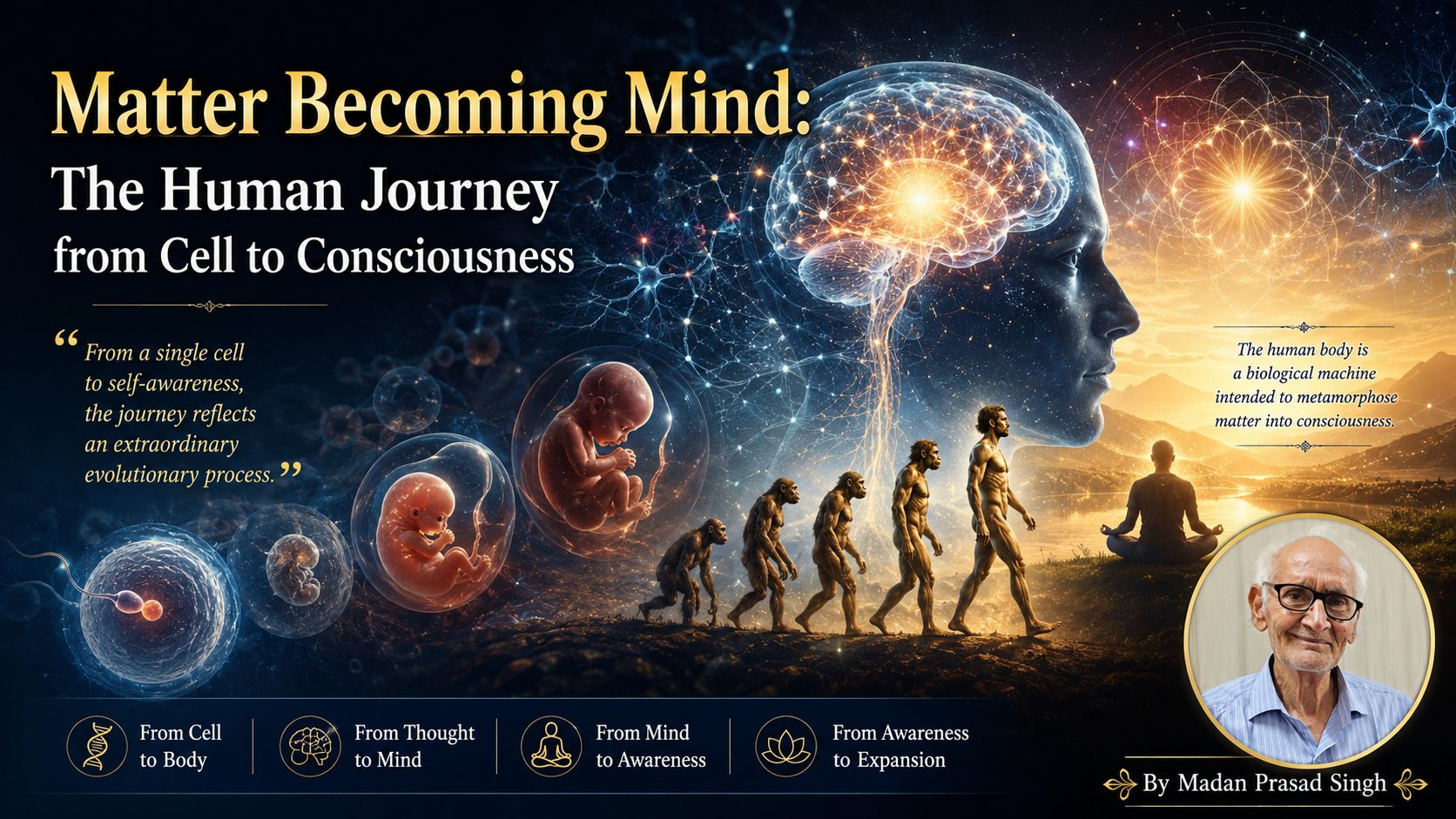
Matter Becoming Mind: The Human Journey from Cell to Consciousness
By Madan Prasad Singh
Among all known forms of life, humans are perhaps the clearest example of how matter can gradually transform into consciousness. A single fertilized cell—formed by the fusion of sperm and egg—silently carries within it the blueprint of a complete human being. From this microscopic beginning emerges a body containing nearly 37 trillion cells, an intricate nervous system, emotions, imagination, memory, and the mysterious sense of “I”.
Science explains much of this transformation biologically. During embryonic development, the monozygotic cell divides repeatedly and differentiates into muscles, bones, blood, organs, and billions of neurons. Yet the greatest mystery remains: how does organized matter become subjective experience? How does the brain generate awareness, identity, and self-reflection?
Humans are metazoans with a clear and distinct “I-feeling”—the inner sense that “I exist.” This I-feeling is mental in nature. Even identical twins, though genetically nearly the same, are never identical psychologically. They think differently, feel differently, develop different personalities, and make different choices. This uniqueness suggests that consciousness is not merely a mechanical assembly of matter, but an emergent phenomenon shaped by experience, learning, environment, and self-directed thought.
Modern neuroscience partially supports this view. Studies on neuroplasticity show that repeated thinking physically reshapes the brain. Thoughts are not passive shadows; they alter neural pathways. In a real sense, what we repeatedly think becomes part of what we are.
Thought may be understood as energy carrying instruction. Electrical impulses travel through neurons, but unlike ordinary physical energy, thoughts possess direction and meaning. A stone rolling downhill has energy but no intention. Human thought, however, can build a bridge, compose music, heal emotional wounds, or start a war. It is energy organized by awareness.
A useful analogy is that of a computer. The brain resembles hardware, while the mind functions more like software—dynamic, adaptable, and capable of self-modification. Yet even this analogy is incomplete because humans possess self-awareness: the thinker can observe his own thoughts. We can ask ourselves, “Why am I thinking this?” or “Should I continue this line of thought?” This capacity for self-observation distinguishes human consciousness from ordinary machine processing.
The “I” is our identity, but it is not fixed. It changes continuously throughout life. A child’s sense of self is simple and immediate. As knowledge, relationships, language, and experiences accumulate, the I-feeling becomes layered and stratified. A student, parent, artist, scientist, or spiritual seeker may all emerge from the same person at different stages of life.
Psychological development demonstrates a similar progression. Children pass through stages of cognitive development, gradually building more sophisticated mental models of reality. Likewise, modern developmental neuroscience shows that the human brain continues restructuring itself well into adulthood.
Our limitations and capabilities are deeply connected to how we think. Repeated fearful thinking narrows the mind, whereas creative and compassionate thinking expands it. Mental activity is like exercise for the brain. Just as repeated physical training strengthens muscles, repeated patterns of thought strengthen corresponding neural circuits.
Every thought creates a mental picture or pattern. These patterns become meaningful because there is a thinker behind them—an observing center capable of judging, continuing, or concluding thought. In meditation and introspection, many people experience this distinction directly: thoughts come and go, yet an observing awareness remains.
The human story, therefore, is not merely one of biological evolution but of the progressive unfolding of consciousness through matter. From a single cell to self-awareness, the journey reflects an extraordinary evolutionary process.
The process of evolution, which was dominant at the biological level, gradually shifted to the mental level. The nerves and glands became more complex. Brain size increased, while proportionately physical capacity decreased. Humans thus became predominantly mental beings. The manifestation of the I-feeling corroborates this development.
Some other species also possess an I-feeling, but they are largely guided by instinct. Humans, on the other hand, are guided by intellect. Our I-feeling is stratifiable into different layers of subjectivity: the doer-I, the knower-I, and still subtler layers. Furthermore, humans can think, “In waking, sleeping, and dreaming states, I am being watched by the One whom I do not see.” When one meditates on such an object, the mind undergoes expansion.
The idea or object that tends to expand the arena of the mind has been called subjectivated pabulum. Our objects of thinking can broadly be classified into subjectivated and objectivated pabula based on their impact on the mind. This terminology was coined by P. R. Sarkar (Ananda Murti), who redefined cells and the process of evolution in a new light to explain the complexity of human behavior, as well as the extent and speed of evolution.
From this perspective, human life itself is an evolutionary journey. The peak of evolution is attainable. We have been designed to evolve much faster by taking advantage of our developed mental faculty and its flexible subjective counterpart, which is stratifiable into different layers of subjectivity, culminating in Supreme Subjectivity. This is the very goal aimed at in dhyana.
Human beings exist at different stages of evolution. Accordingly, some are predominantly instinctive, some intellectual, and still others spiritual. The full spectrum of reality—from matter to consciousness—can be observed in fully evolved human beings.
The human body is a biological machine intended to metamorphose matter into consciousness.
When we think about something, the idea is projected by the objective mind. The subjective layers then perform their respective roles in portraying, witnessing, and evaluating it.
What can be portrayed by the objective mind is considered objective reality.
