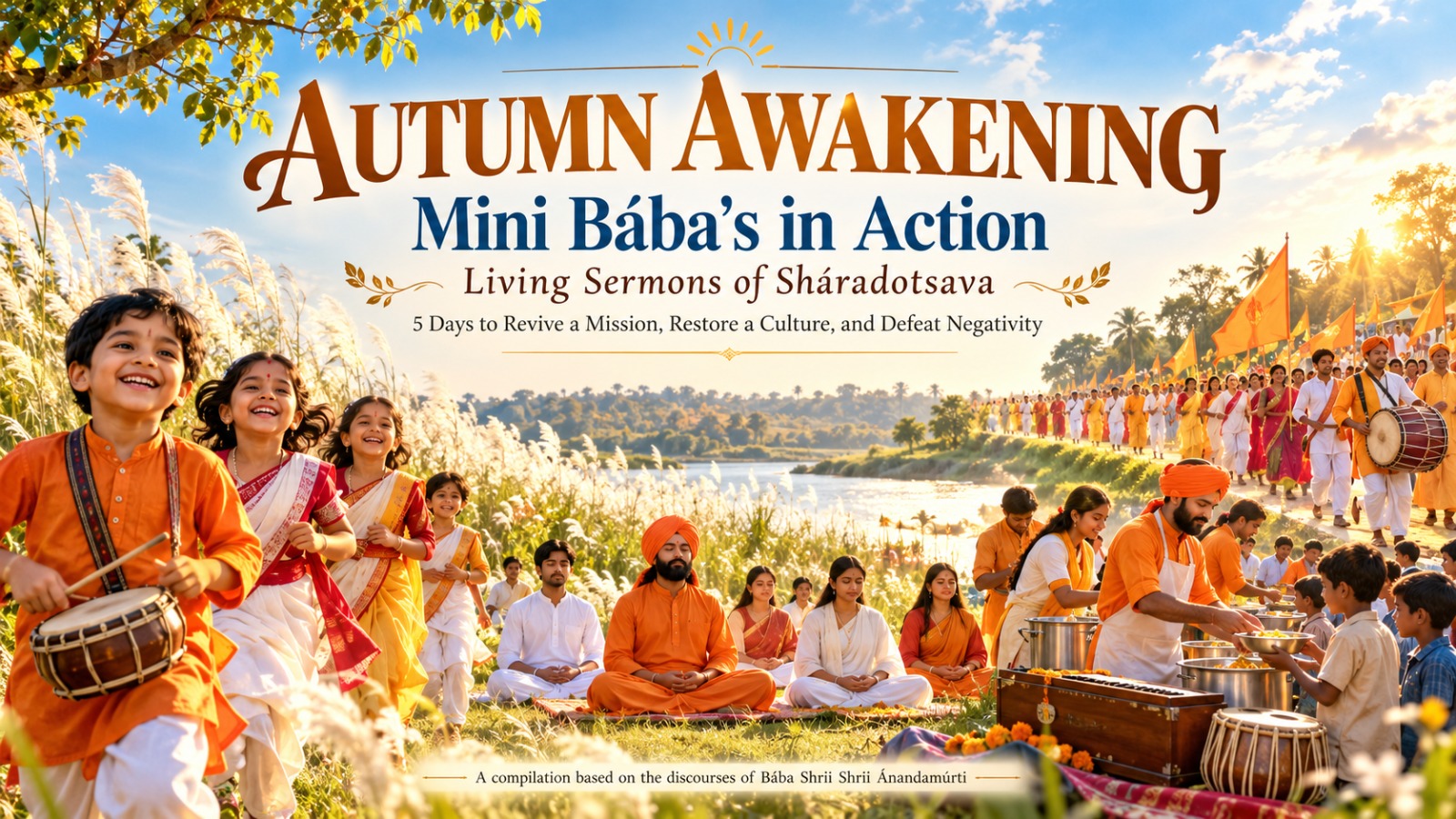
AUTUMN AWAKENING – Mini Bábá’s in Action
Living Sermons of Sháradotsava – From Children’s Smiles to Vijayotsava – 5 Days to Revive a Mission, Restore a Culture, and Defeat Negativity
A compilation based on the discourses of Bábá Shrii Shrii Ánandamúrti
Edited by Ácárya Gatimayánanda Avadhúta – CTS, Sweden
The Complete Call of Beloved Bábá
This is a reverent call to action for all followers of the Ánanda Márga ideology, urging a renewed commitment to the principles of Neo-Humanism and the establishment of a benevolent social order.
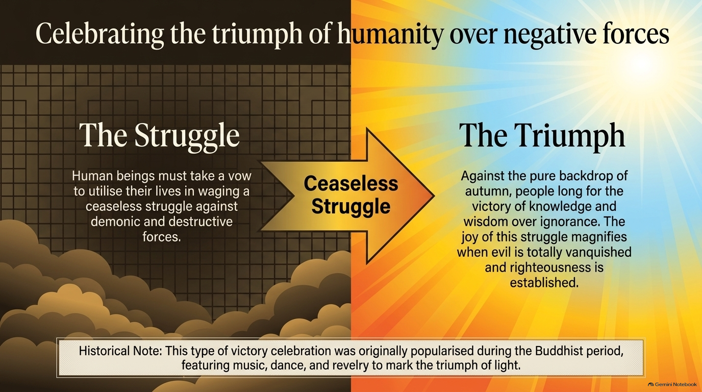
Our Beloved Bábá explains that Sháradotsava, or the Autumn Festival, is far more than a celebration. These five days serve as a symbolic victory of righteousness over evil. Taking place in early autumn, amidst pure skies, gentle breezes, and blooming Ka’sh grass, when people naturally reflect deeply on life, the festival uses the purity of the season to inspire a tireless struggle against all destructive forces.
The true pioneers of our past spread the mission far and wide with a dazzling, dedicated spirit. They taught and implemented Beloved Bábá’s system of social ceremonies, structural guidelines, and the profound message of Neo-Humanism.
Ánanda Váńii on 1st October, 1977.
Our Autumn Festival is a call to revitalize that same spiritual and social commitment.
That which renews human existence and makes it full to the brim and overflowing with the joy of living is termed a festival. Let Sháradotsava (autumn festival) inspire all people to live with a new spirit like true human beings. Let it inspire them with the fact that all humanity is an indivisible entity. On this auspicious day this is my inner wish.
The Spiritual and Seasonal Significance
Bábá’s message masterfully integrates spiritual duty with cultural and seasonal cycles.
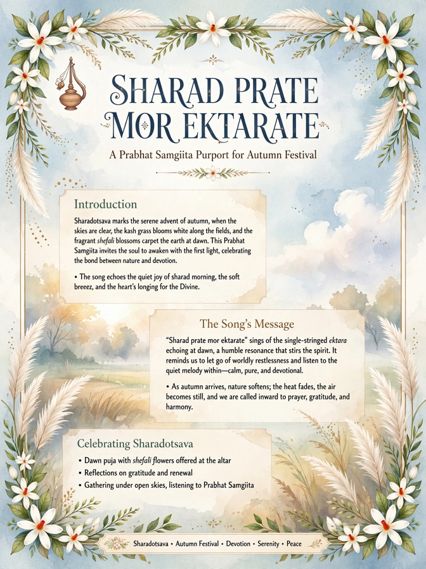
1. The Triumph of Good: The festival celebrates the ultimate victory of humanity, righteousness, knowledge, and wisdom over negative forces and ignorance. If we ponder its historical roots deeply, we find that it continues a long tradition of victory celebrations popular since the Buddhist period. This profound sentiment is also captured in Prabhát Saḿgiita #120 to #125, composed by Beloved Bábá Shrii Prabhát Raiṋjan Sarkár.
2. The Lunar Calendar System: The festival is calculated via the traditional Indian lunar calendar system. It was once supposed that the earth is fixed and the moon revolves around it. Of course, in actual fact, the earth is not fixed but revolves around the sun. The moon also rotates, and it takes anywhere from 28 to 31 days for the moon to complete one full cycle – a lunar month. If we multiply the lunar month by 12, we get a lunar year of 354 or 355 days.
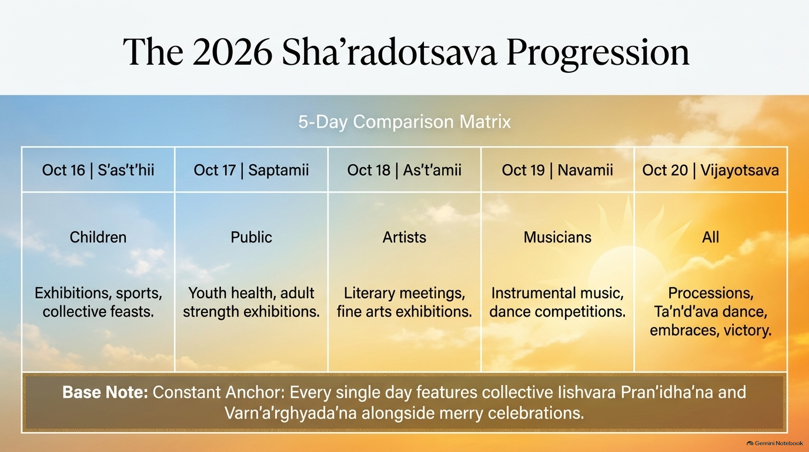
In this system, Sháradotsava is celebrated from the 6th to the 10th day of the bright fortnight following Áshvina, the sixth month of the lunar year.
For the current year, the dates correspond to:
This system connects these timings to cultural traditions worldwide and to our duty of environmental conservation.
The Five-Day Programme of Victory
The festival outlines a specific five-day programme that celebrates humanity’s victory over evil through collective discipline, service, music, fine arts, and sports.
Day 1: Sas’t’hii – Children’s Day
This day features collective Iishvara Prańidhána and Varńárghyadána, children’s sports and exhibitions, and collective feasts.
Day 2: Saptamii – Public Day
Dedicated to all non-children, this day includes youth health exhibitions and adult sports and strength-display events.
Day 3: Ast’amii – Fine Arts Day
A day for literary meetings and fine-arts exhibitions, alongside collective worship.
Day 4: Navamii – Music Day
Dedicated to musical performances, instrumental recitals, and dance competitions.
Day 5: Dashamii – Vijayotsava – The Festival of Victory
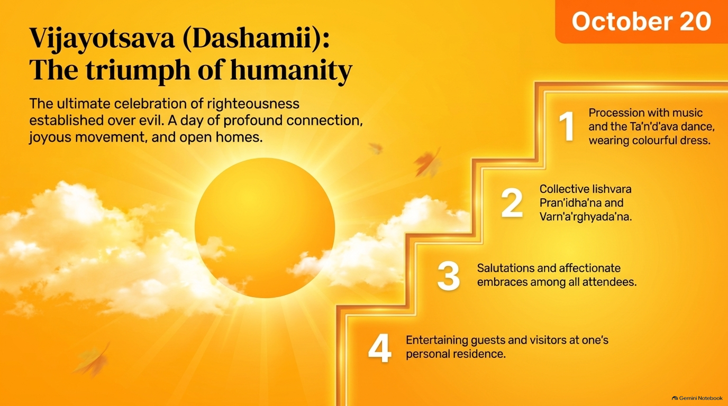
The grand culmination. It features a magnificent procession with music and Táńd́ava dance, participants in colourful dress, mutual salutations, affectionate embraces, and the warm hosting of guests.
The Living Philosophy in Practice
Central to the message is the importance of collective meditation and disciplined service as the means of establishing a just society.
1. A Universal and Boundary-Free Mission:
Ours is a universal mission, designed to be propagated across all global sectors without any barriers of caste, creed, colour, or country.
2. Local Unit Engagement and Teamwork:
The practical application of this mission takes root at the community level, when Margiis, Ácárya’s, and sympathizers gather in local units for collective meditation, collective meals, and shared responsibilities. Teams work together to contribute progressive ideas to broader society. Carrying out this social mission requires the same dedicated spirit as the early pioneers, driven by the core rule that “Discipline is Obedience and Obedience is Discipline.”
3. Actions as Living Sermons:
The ultimate measure of ideological implementation is practical conduct. Devotees are viewed as living symbols – as “mini Bábá’s” – whose daily actions, ethical conduct, and selfless service in the world serve as the true living sermons of the Supreme Preceptor, Bábá. Our social conduct and collective discipline are the true physical manifestation of His teachings.
4. Cultural Traditions and Ecological Responsibility: Our cultural traditions must be based on both ancient wisdom and the modern scientific understanding of the progressive development of all members of society. This also includes our environmental ethics and protection, with a strict injunction against killing small fish (under 1/4 of adult size), infant fish, or pregnant fish – for example, female hilsa during the period from mid-autumn to the Phálguna full moon.
Our daily programs and activities are locally oriented as per the decision of each unit. Ultimately, the message reinforces that we, as practitioners, act as living symbols of our Supreme Preceptor, BÁBÁ, and it is through our ethical and disciplined lives that His vision for a new humanity will be realized.
