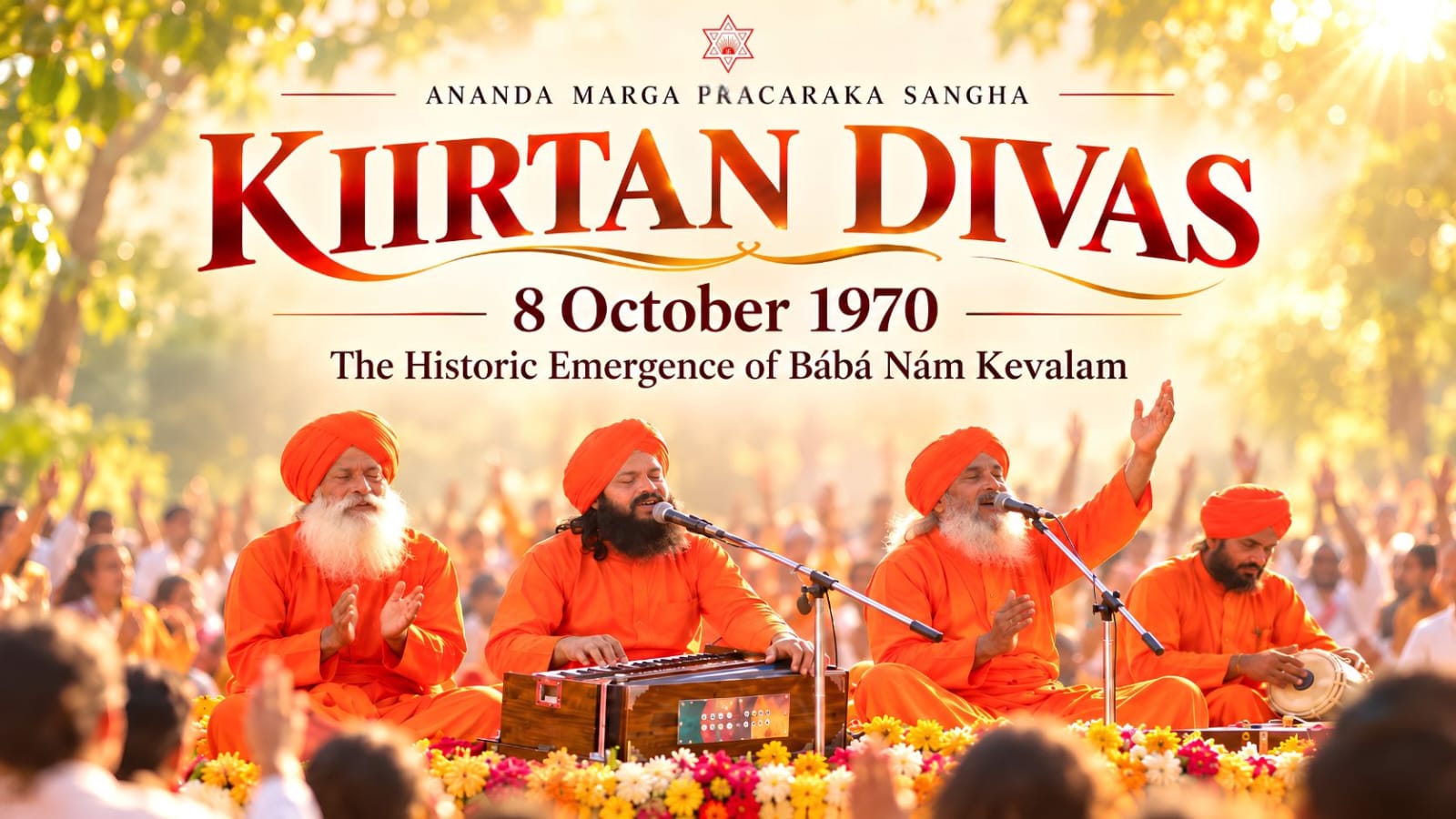
ETERNITY MANIFESTED IN TIME: THE HISTORIC EMERGENCE OF KIIRTAN ON EARTH — BÁBÁ NÁM KEVALAM, THE AŚT́ÁKŚARII MAHÁMANTRA

ETERNITY MANIFESTED IN TIME: THE HISTORIC EMERGENCE OF KIIRTAN ON EARTH — BÁBÁ NÁM KEVALAM, THE AŚT́ÁKŚARII MAHÁMANTRA

edited by Ácárya Gatimayánanda Avadhúta (CTS, Sweden)

The Ineffable purpose and resplendence of Kiirtan invention. In the rigorous study of spiritual evolution, Kiirtan emerges not merely as a devotional act, but as a strategic technology for the elevation of human consciousness. As a senior historian and spiritual archivist, one observes that the efficacy of any mantra is inextricably linked to its systematic origin; to understand the precise moment of its inception is to touch the “Acoustic ensouled sound incarnate of Bábá” at its most potent rootage.

Shrii Shrii Ánandamúrti (affectionately known as Bábá) defined the “resplendence” of Kiirtan as its innate capacity to bridge the finite with the infinite, transforming the practitioner’s internal environment through a scientifically structured acoustic intonation of cosmic rhythm.

The core objective of this record is to document the specific historical juncture on 8 October 1970, when the Aśt́ákśarii Mahámantra —the eight-syllable “Bábá Nám Kevalam”—was formally offered theophonic gift to humanity. This revelation was not a casual event, but a meticulously timed projection of universal grace that necessitated a journey deep into the primordial silence of the Amjharia Forest.

The journey to Amjharia was the prelude to the revelation of 6-7 October, 1970. This compilation is based on the eyewitness account of Shrii Tirath Nath Jii on the origin of the Aśt́ákśarii Mahámantra, beginning when Ácárya Shankaránanda Avadhúta went to his house to inform him that he was to accompany Bábá’s family as a security guard.

The secluded, natural setting of the Amjharia forest served as the necessary crucible for this spiritual milestone, providing a sanctuary far removed from the clamour of urban distraction. The exodus from Ranchi Jágrti commenced under the cover of evening on 6th October. At noon the following day, the entourage comprised Bábá, Marga Mata, Bábá’s son, and their personal cook. The security detail, charged with safeguarding Bábá and His worldly family, included Vishnudev Jii (VSS Personal Security In-charge) as the driver and a doctor named Chakravarti. The narrator of the entire incident was none other than Shrii Tirath Nath Jii — the security guard of Beloved Bábá at Ranchi and the Laokik father of Ácárya Priyabodhánanda Avadhúta — who was interviewed by our correspondent.

Significantly, given the wild and unpredictable nature of the jungle, the detail narrator carried two guns for protection—a stark reminder of the physical stakes underlying this metaphysical journey.

By approximately 5:30 PM on 7 October, the convoy ascended to the Amjharia forest rest house approximately 60 Kilometres outskirts from Ranchi, an isolated structure perched 800 feet above ground level. The scenery was nothing short of heavenly, a landscape vibrated by the presence of Devayoniis (divine creatures) and various luminous bodies that haunted the high forest.

This celestial atmosphere was briefly pierced by a “Liila” of worldly chaos when two Ambassador cars arrived, carrying intoxicated visitors who rudely demanded entry. As the security detail stood firm, adhering to their instructions to protect the enclave, Bábá witnessed the confrontation from His chair on a round concrete platform, enjoying the display with a slight smile on His face. This incident served as a profound contrast between the intoxicated agitation of the mundane world and the poise of the Mahásadvipra Bábá.

As night fell, the forest became “terrifying,” yet Bábá led the group on walks deep into the jungle during the dead of night. Under the pale light of the moon, the environment was thick with the threat of wild animals, yet the group followed Bábá’s magnetic lead, unable to question the destination. This period of intense, shadowed anticipation in the heart of the wilderness set the stage for the following day’s historic revelation.

The historical innovation on the 8th of October 1970 stands as the definitive moment when Mahásambhúti declared Aśt́ákśarii Mahámantra Kiirtan “Encrypted embedded covert acoustic resonant signature(name) of Bábá” was transformed into a universal tool for liberation.

The day began with a demonstration of spiritual yearning at the compound gate. Shrii Brahmadev Ji, a local devotee, arrived seeking an audience but was initially barred by the personal guard of Volunteer Social Service (VSS – Universal Peace Service Force) security. His response was a poignant philosophical plea: “How can it be that a father does not allow His son to meet Him?”

Denied entry, he sat beneath the trees nearby, repeating “Bábá, Bábá” with unwavering focus.

At 2:00 PM, the Mahásambhúti Bábá summoned Shrii Brahmadev Ji. Following their private encounter, Bábá emerged and personally pronounced the eight syllables that would alter the course of spiritual history: “Bábá Nám Kevalam.”

The birth of eternity on earth occurred in a setting of profound humility — a cleaned-out garage beneath the rest house. In an ironic twist of history, the inaugural chanting and dancing of Kiirtan took place without a single photograph of Mahásambhúti Bábá or any ornate altar. Initially, the practitioners focused on the Kiirtan laya (tune), but the practice rapidly evolved.

On 9th October, even as few Sannya’sii Dadas (monks) arrived and were refused entry to preserve the sanctity of Bábá’s family time, the Kiirtan intensified with divinely devotees “Oh Nárada, I reside where my devotees do my kiirtan.” In other words, “I go where my devotees are doing kiirtan, where they are creating the Hari Pari Mańd́ala Gosthi.”

Viewed in retrospect today, the reason for restricting entry into Ranchi Jágrti at that time becomes evident. A small faction, having colluded with vested interests and anti-social elements supported by the then Government of India, was engaged in a conspiracy to divide the organization and to instigate the persecution of Beloved Bábá. Heightened security, therefore, became essential.

After millions of animal lives, created beings attain human forms. That is why all the scriptures speak of the rarity of human life. The wise make proper utilization of all objects – this utilization alone makes the existence of the object worthy. You have achieved human frame – you must make it meaningful by your sádhaná (spiritual practice), service and sacrifice. Engage yourself in such useful pursuits that even the worst of your enemies hardly has any chance to despise you; utilize yourself in such a manner so as to have satisfaction in your mind also, that you never wasted your time uselessly on this earth.

(Ánanda Vanii, May 1970)

The group grew to seven or eight individuals, including a “short-looking figure” who served as the local postmaster and devotees from Daltonganj.

Over these 48 hours, they refined the kiirtan with Raga and Chanda (vibrant rhythm), singing for hours into the night. On the morning of 10 October, after a final Kiirtan session, the entourage departed for Ranchi, leaving behind a forest forever changed by the introduction of this new acoustic supra-aesthetic providential scientific Aśt́ákśarii Mantram.

The occult science and cosmic power of the Aśt́ákśarii Mahámantra is not a mere religious chant; it is a “Covert Acoustic Algorithm from Saḿskrtá for Cosmic Consciousness” tool—a Mahásiddha Mantra designed for systemic human transformation. Its efficacy relies on the Lalita Marmika spiritual dance and precise mental ideation. For collective practice, the mind is fixed upon the Sahasrára Cakra, while solo practitioners focus on the TRIKUT́I(lunar) plexus. These focal points are the gateways through which the tanmátras (vibrations) of the mantra are projected.

Parama Puruśa has created variegated sounds, colours and continues to create them.

Wherever there is any semblance or sign of existence there is bound to be a corresponding vibration(Cosmic rhythm), and that vibration must be associated with some inferential expression (tanmátra) or the other. Do you understand?

A vibration is always dependent on an inferential expression (tanmátra). Different tanmátras are associated with different vibrations. That is how, from these vibrations, inferences such as sound, touch, form, taste and smell continue to saturate the universe. Since they are associated with the tanmátras, sound, touch, form, taste and smell emanate from their respective vibrations and permeate the universe. So, wherever there are vibrations, there must be sound, touch, smell, form, taste, and they all come within the scope of perception.

The archival records detail the comprehensive “Acoustic Science of the New Nádá” that impacts the human unit across several strata.

Firstly the physiological and neural purification of the mantra purifies all sensory and motor organs, including the nerve cells, fibres, and controlling nuclei.

Secondly, the anatomic resonance, which vibrates the molecules of both the ectoplasmic and endoplasmic anatomy, ensures a deep-seated biological realignment and strengthens the psycho-physical immunity of the sádhaka.

Thirdly, systemic protection, which acts as a shield. In the context of the present world scenario, this protection is profoundly relevant. It offers a defence against worldly diseases and pandemics, natural disasters such as floods, earthquakes and famine, as well as man-made atrocities such as nuclear war, ecological collapse, and global conflicts. Furthermore, it provides protection from the malevolent influences of Avidyá Tántrikas and negative microvita.

Lastly universal reach through the agency of Microvita in which the vibration of “Bábá Nám Kevalam” is carried via universal acoustic waves throughout the astronomical universe, revitalising the entire cosmos.

This mantra represents a “New NÁD́Á,” a sonic wave capable of purifying the átman (soul) and providing a pathway for the total liberation of all created beings in physical, mental and astral world of animate and inanimate.

This determination is a legacy of universal grace, the transition of the “Bábá Nám Kevalam” mantra from a secluded forest garage to a global phenomenon is an official document to its inherent power and universal grace. Every year, the 8th of October marks the historic moment when Bábá’s Saḿkalpa materialized as a universal endowment — the Mahámantra Bábá Nám Kevalam” for the entirety of creation. The systematic origin of this mantra in the Amjharia wilderness remains a cornerstone of spiritual history—a moment where the Supreme Lord put into words a rhythm that continues to float through the cosmos. It remains an enduring, vibrant Kiirtan Chanda, showering graceful and powerful vibrations upon all who choose to listen and sing, leading humanity toward an era of unprecedented spiritual clarity.

Due to constant repetition, the mantra is sounding in one’s ear. While sitting in meditation, a sádhaka moving around can see Iśt́a, and the fragrance of sandalwood comes from the body of the Iśt́a. Sometimes one gets it and sometimes one does not get it.

The fourth stage is known as vashiikára. There a Sa’dhaka is established in the ideation of Parama Puruśa, to satisfy whom that Sádhaka is doing kiirtan. Here one completely surrenders before Parama Puruśa, and Sádhaka is under the complete control of Parama Puruśa.

So there are four stages – four stages one at the time of inhalation and four stages again at the time of exhalation.

So in all there are eight facets, and a siddha mantra must necessarily have eight syllables – it must be aśt́ákśarii, as each and every syllable of an Iśt́a mantra has got its own importance.

Bábá nám kevalam is manifest as a siddha mantra.

When the first syllable Bá is uttered, the feeling should be, “I am crossing the threshold and entering the new world;” and when the last syllable “ma” is uttered, the feeling should be, “I have accomplished my duty.”

If the kiirtan is done with these sensitiveness, within two-three minutes the effect will come into play.

The whole siddha mantra should be uttered fully in each phrase of the tune – Bábá nám kevalam – and not a part of it – while doing kiirtan. If this is not done, the kiirtan cannot be said to be a perfect kiirtan. Everything must be done in a methodical way. Then you will enjoy and get the manoeuvrer of kiirtan decorous.

Ink of the Heart, Tune of Eternity: “44th Prabháta Samgiita Divas – The Dawn That Never Ends”

edited and complied by Ácárya Gatimayánanda Avadhúta (CTS, Sweden)

“The feeling of the heart… written with the ink of the heart.”
— Shrii Prabhát Rainjan SarkárÁnanda Vánií Samgraha

“All the beings of this universe are the kith and kin of one another. No one is despicable. All are equally respectable and entitled to equal love and affection. No problem is to be ignored as an individual or group affair. Every problem is to be considered as the collective problem of universal humanity and is to be resolved collectively, and resolved it must be.
Let it be the vocal panorama of the newer world of today – the continuous musical notes behind the movement of Neo-Humanism.”
— Ánanda Púrnimá, 1982

On September 14, 1982, in Deogarh, the first rays of a new musical dawn broke. On that day, Shrii Prabhát Rainjan Sarkár, lovingly called Bábá, composed the first song of Prabháta Samgiita, subtitled “Rays of Crimson Dawn in Musical Symphony.”

What began as a single composition blossomed into a universe of 5,018 songs created over 8 years, 1 month and 7 days (2,957 days), concluding with Song No. 5018 on October 20, 1990, in Tiljala, Kolkata.

This September 14, 2026, we celebrate not just the 44th Prabháta Samgiita Jayantii (birth anniversary), but a phenomenon that is globally unique in the history of music.

No composer in known history has created such a vast original body of work — both lyrics and tune — with such speed and precision.

The journey started in Deogarh and travelled through Ranchi, Anandanagar, and even hospitals, cars, field walks and trains. The vast majority were given in Kolkata — 3,749 songs at Madhu Málainca and 602 at Madhu Koraka.

On November 20, 1984, Bábá created world history by composing 15 songs in a single day (No. 2101–2115).

Each song was dictated to a three-person “Ga’n Party”. Bábá would first hum the melody twice and seek approval, then sing the lyrics and tune together at lightning speed while attendants transcribed them.

Bábá made them sing it back until it was rendered perfectly accurate, and often explained profound philosophical details connected to the song.

Having already established the philosophical framework of His mission, Bábá now gave it in musical form so that everyone could internalize it easily.

Formally spelled Prabhát Samgiita, it signifies the dawn of a new era that dispels static sensory pleasure and ushers in transcendental devotion.

Bábá defined true Samgiita as a synthesis of Giita-Vádya-Nrtya (song, instrumental play and dance), built on four pillars: Bháva (idea), Chanda (rhythm), Sura (melody) and Bhásá (lyrics).

“Phonetics depends on the science of breath, on inhalation and exhalation. Also on the basis of the science of breath, Shiva invested the world of rhythm with mudrá.”

It moves from Nandan Vijiinána (aesthetic science) to Mohan Vijiinána (supra-aesthetic science) — enabling the practitioner to merge into Divine Enchantment (Mohana).

Its purpose was clear: to establish a brand-new Gharáná — a new musical school with its own identity, and to serve as a spiritual tool for Sádhaná, vibrating with devotion and deepening love for the Supreme Loving Father.

The Science of Uniqueness: What Makes It Globally Different

Its linguistic mastery and lyrical craft are unparalleled. While predominantly in Bengali — chosen for its high proportion of Samskrta root words allowing subtle expression — the collection spans eight languages: Bengali, Samskrta (9 songs), English (3 songs: No. 68, 5008, 5009), Hindi/Urdu (∼20 songs), Maithili, Angika and Magahi. Its sweetness lies in the science of blending Komala-svara (soft consonants) with Kathor Dhvani (hard sounds). Bábá even introduced Pluta-svara (extra-long vowels) for Kheyal-style rendering.

Yet, Bábá assured that learning Bengali is not mandatory to reap its spiritual and therapeutic benefits.

This musical diversity is an ocean of all genres in one. Prabháta Samgiita is an ocean containing all rivers of musical Rágas. It incorporates 6 primary Rágas and 36 Ráginiis, including the revival of ancient modes like Diipak Rága from Lord Shiva’s era, plus many unnamed new Rágas created by Bábá Himself. Bábá gave genres for most songs, such as Dhrupadi, Kheyal, Tappa, Thumri, Ghazal, Hava-Ghazal, Qawwali, Baul, Jhumur, Bhatiyali and even international melodies — Scandinavian, Israeli, Chinese, Swedish and Persian.

Bábá explained the evolution of instruments while rendering this lyrical symphony. The Flute (Banshii) from hollow bamboo was the first natural instrument; Ektárá was the oldest stringed instrument, which Lord Shiva perfected into the Viiná (Shivakona) to align with the Sura-Saptaka (seven notes).Bábá traced the Tabla to Mrdanga in India, Sitar to Persia, and Violin to Italy. He taught that tuning strings teaches Majjhimá Márga — the Middle Path — neither too slack nor too strained to breaking point. Bábá distinguished a Samgiitajinána (vocal virtuoso) from a Shilpii (instrumental artist displaying hand dexterity).

Over half a century later, on 6th October 1985, during a discourse on linguistics in Calcutta, Shrii P. R. Sarkár recounted an experience which gave an insight into the pastimes of His early days in Jamalpur: “At that time I used to walk in the hills to the east of Jamalpur nearly every day. After dark, these terrifying places became young Shrii Prabhát Rainjan Sarkár’s private refuge — a vast expanse of desolation far from the hustle and bustle of the world where no one would disturb Him. Often when people returned home around dusk, they saw Him walking towards the hill. At times He would carry a flute and spend hours experimenting with different tunes or playing the Sindhu-Bhairavii Rága composed by Lord Shiva 7,000 years ago, which had since become defunct.”

At other times, He played Meghamallár (a Rága capable of attracting clouds and bringing rain) or Multánii Vasanta. He spent several evenings alone there experimenting with various Rágas and blending them on His flute.Sometimes His friend, Prasenjit, would accompany Him, bringing his Esraj. Nobody had ever seen Shrii Prabhát Rainjan Sarkár learning the flute or any other musical instrument. So it was generally believed that, like everything else, He acquired vast knowledge of music from a mystical source.

In His home, an academic atmosphere prevailed. Music was also encouraged, along with reading, discussions and studies. Mother Abharani was a good singer. Shrii Prabhát Rainjan Sarkár’s elder sister, Hiiraprabhá, also learned the songs of Rabindranath, Nazrul, Atul Prasad, Dijendra Lal and Rajani Kanta. Pandit Hiyalal Jha gave her Sitar and Violin lessons. Shrii Prabhát Rainjan Sarkár used to sit beside His elder sister listening intently. During the summer holidays, Shrii Lakshmi Narayan would take the family to Bamunpara for about a month.

Some sources have told us that Bábá used to teach dance at that time.

Beloved Bábá knew each culture has its unique traditions, styles and techniques, shaped by history, geography and social context. From the intricate footwork of Indian classical dance to the energetic rhythms of African drumming, each tradition has its own beauty and significance — like Ajay Valley, Italy, Spain, Portugal, Bengal, Malraki Valley, Albania, Belgium, China, Kangasvati, Damodar, 1,500-year-old Buddhist Tantra, Giiti Roy, Suvarnarekha Valley, Scandinavia, Middle East, Europe, Ganga Valley, Aosta Valley, 2,000-year-old Punjabi, Kashmir, Persian, Karnataka and South India, with the melodic Gharanas of Ghazal, Qawwali, from Rága Diipaka from the time of Shiva, Shivaranjani, Jaunpuri, Tappa, Tintal and Bageshrii Gharana, etc., which can be played in Prabháta Samgiita melodies.

The Impact of Song, Dance and Instrumental Percussion

All this, Prabháta Samgiita has a profound impact on our lives, influencing our characteristic bearing of sentiments, both devotional and emotional, thoughts and behaviours. It has the power to:

Evoke strong emotions and create a sense of connection

Preserve cultural heritage and traditions

Provide a means of self-expression and creativity

Bring people together and foster community

Influence our mood, energy and well-being in the all-round development of physical, mental and spiritual spheres.

The spiritual and healing essence of these songs expresses every shade of the devotee’s heart — from intense Viraha (separation) to Madhur Bháva (divine union), along with universalism, social awareness and Neohumanist love for nature. Bábá introduced the concept of Ajána Pathik — the Unknown Traveller, representing Táraka Brahma playing hide-and-seek with creation.

This is more than devotion; it is therapy. Rágas stimulate nerve fibres and vital energy, offering help for conditions like hysteria, melancholia, gout, epilepsy and nervous exhaustion.

Gandharva Microvita assist in recovering lost melodies and awakening subtle devotion. Five songs (No. 154, 158, 159, 162, 163) were designated as compulsory for collective spiritual functions.

Scholarly musicians like Prof. Ramaranjan Mukherji and Dr. Subhas Sarkar, to whom the work is dedicated along with maestros Ramnidhi Gupta (Nidhi Babu) and Ustad Alauddin Khan, have highlighted its role in rescuing the spiritual supra-sensuous from material degradation.

For every moment of life, Prabháta Samgiita is not only for meditation. It contains specific songs for every social function and various uncountable themes — from Brahma to a blade of grass — such as weddings (No. 58), baby naming (No. 59), house entry (No. 137), tree planting (No. 136), birthdays and seasonal festivals. Kiirtan itself functions as Lalita Dance — a fine art (Lalitakalá/Cárukalá) that expands the mind.

To popularize it, Bábá structured cultural forums such as RAWA, Spandanik, Chándosik, Nándosik and Surasaptak.

Official Release Note:

44th Prabháta Samgiita Divas — Inauguration of the Prabháta Samgiita Gharáná AI Platform

On the spectrum of this new era, our Central Administration is proud to unveil a new vista in the form of an Artificial Intelligence App, released on the auspicious 44th Anniversary of the Inauguration of the Prabháta Samgiita Gharáná.

This intelligent platform is designed to offer website visitors a vast array of foresight and deeper insight into the songs. It provides extensive resources — including audio recordings, translated lyrics and musical notations — to help seekers engage deeply with the collection’s devotional themes. By categorising the songs according to language and varied themes, the site ensures easy navigation through these expressions of spiritual bliss.

In addition, the Ánanda Márga archive provides educational materials on linguistics and musicology, along with unique live recordings that capture the historical performances of these pieces in Bábá’s presence. Ultimately, this resource aims to help individuals transcend mundane existence through the emotional and aesthetic power of sacred song.

Today, its preservation and presentation are spearheaded by Prabháta Samgiita AI, under the Ánanda Márga Web Team led by Dewasheesh Rana, along with the Deepeshvara PR team. This team is releasing the new website and App with the complete archive of lyrics, translations, notations (Svaralipi), and almost all 5,018 MP3s plus historical live recordings.

The Prabháta Samgiita AI App features:

Daily Inspiration for spiritual reflection

Discovery of Ánanda Márga activities along with daily news

Mood Synchronisation, to explore your inner thoughts and emotional states

Interactive Learning, to thoroughly explore each Prabháta Samgiita through quizzes, melody analysis and other musical dimensions.

This entire endeavour has been subjectively synchronized through the selfless efforts of various devotees who have dedicatedly provided transliteration and profoundly rendered the lyrics into English. This legacy is now cloned and elevated through AI on our official portal: www.prabhatasamgiita.net

On this Prabháta Samgiita Divas, 2026, we do not just listen to music. Shrii Prabhat Ranjan Sarkar (Bábá) manifested Prabháta Samgiita to establish a brand-new Gharáná with its own distinct musical identity.

It was Bábá’s direct instruction and guidance, because it was an entirely new musical school rather than an existing tradition. Singers could not simply rely on conventional training. Complex classical compositions frequently required Bábá’s direct guidance, personal demonstration and repeated corrections to ensure the songs captured the authentic refinement and rendering of this new Gharáná.

Today, we are crossing the threshold to enter a new Gharana, a new dawn, where Oriental mudrá musicology meets Occidental rhythmology, where a song is Sádhaná, and where 5,018 flowers bloom from one heart to guide humanity from Nandan (Aesthetic) to Mohan (Supra-aesthetic).

Bábá Nám Kevalam.
Prabháta Samgiita Kii Jai!
Parama Pitá Bábá Kii Jai!

THE CHANGELESS PARAMA PURUŚA—BABA WHO IS OUR CREATOR OF THE PATH TO ETERNAL KNOWLEDGE AND GRANTER OF LIBERATION.

HAPPY NEW YEAR – 2026
As we stand at the threshold of a New year, 2026, we find ourselves amidst the chaos of a world in constant flow or flux. Amidst the short-lived nature of all things, there lies an eternal truth that transcends the boundaries of time and space.

This truth is embodied in the concept of Parama Puruśa, the Supreme Lovable Being, who is the only knowable entity for devotees who are His loving unit beings.

In the vast expanse of existence, BABA alone is worthy of our knowledge, devotion, and contemplation.

The Singular Focus of Knowledge is the only pursuit of knowledge which is a fundamental aspect of human nature.

We seek to understand the world around us, to unravel its mysteries, and to grasp the underlying reality.

However, the complexity and diversity of the universe can often lead to confusion and fragmentation.

In the midst of this complexity, Parama Puruśa stands as the singular, Non Causal entity, even though Baba knew during in His time, that digital world will be booming to throb the world replacing and conquering the trend from last century electronic media into nuclear era in all facets of society, so Baba has provided us all Ideas how to move on.

Baba, being our dearest and nearest guide, always encouraged to sacrifice for the cause of the uplifting suffering humanity, as well follow loyalty to Baba’s organization, which Baba Himself built with so many sacrifices by His children both family and sannyasiins and expects all Ananda Margiis to rely and carry the responsibility 24/7, so for this New Year 2026, let us move towards true nature of understanding His mission in this age of Artificial Intelligence and in progressive way to adopt the socio-economic-cultural-ecological, ethical, supra-scientific transformation bringing our Baba’s knowledge house to house, person to person and implement, materialize, all His works into practical world.

Baba’s kaleidoscopic mysterious microvita is the thread that weaves working through the fabric of monumental existence of His devotees, for the unchanging essence that underlies all change individually and collectively to establish sadvipra samaj. The Seed of Existence of this universe, in all its manifest and unmanifest forms, finds its seed in Param Puruśa Baba, this universe, in all its manifest and unmanifest forms, finds its seed in Parama Puruśa Baba.

Baba is the Source from which all things emerge, and to which they return. This understanding imbues us with a sense of unity and interconnectedness, as we recognize that everything is an expression of the same Baba’s divine essence.

In knowing Baba through 16 points, and love for Ista and Adarsha (Ideology) etc, we gain insight into the nature of existence, and the mysteries of the universe are revealed to us.

The Panacea for All Ailments in this world is nourished with suffering and imperfection. We are beset by physical, mental, and spiritual ailments that seem insurmountable. However, in the presence of Parama Puruśa Baba, all these afflictions find their cure, rectification, resolution etc.

Baba is the panacea, the ultimate redeemer of all problems individual, collective, personal, which can soothe the deepest wounds in all aspects or realms in the physical, intellectual, social, moral, sacramental, cultural, economical, etc and finally bring peace to the troubled mind for one and all.

By following His command only, we can find solace in the midst of turmoil and discover the strength to overcome our limitations by surrendering to our Ista & Ideology.

The Path to Liberation, is certain as we embark on this New year 2026, we are reminded of the importance of ceaseless effort and endeavour to establish Prama generating positive microvita by our tireless efficiency of following His Supreme Command.

So Lord Shiva has said, Jiṋánasyáyaḿ bhásate nányatha eva – “It suggests that true knowledge is the only thing that truly shines or brings light to our lives. Other things may seem important, but they are fleeting or illusory. Knowledge is enduring and transformative. Of all knowledge, only this remains.” (Namah Shiváya Shántáya, 138)

In Baba’s words – You all have come for good of nothing; Better are coming for doing something  & Best are yet to come to accomplish everything.

In the pursuit of Parama Puruśa Baba, we find the key to liberation from the cycle of birth and death, from the limitations of the ego and the confines of the material world.

By ideating upon our Ista Mantra and Guru Mantra, by knowing how to practice in perfection to know how to Love HIM ONLY, and by surrendering to His Will, we can transcend the boundaries of the finite and experience the infinite Bliss where Baba resides that is Only Baba’s name exist – Baba Nam Kevalam.

Focus your Determination, as we welcome the New year 2026, let us engross our minds and hearts on the eternal truth of Parama Puruśa Baba and serve the entire world of His.

Let us recognize Baba’s presence in all aspects of existence and strive to know Baba in His fullness.

May this above-mentioned knowledge guide us on our journey through the complexities of life, and may we find peace, liberation, and fulfilment in the realization of the Supreme Beloved by rendering our best Seva to Baba and His Ananda Marga Ideology.

By embracing this profound understanding, we can navigate the challenges of the New year 2026 with cognitive intuitional practice that is performing Sadhana very sincerely and strictly, complacent, bravery, and outlook.

Ánanda Váńii Saḿgraha: from 3 Collection of the Incorporeal or Non Causal Blessings of Shrii Shrii Ánandamúrti

(34) Just as the advent of the purple dawn is inevitable at the end of the cimmerian darkness of the inter-lunar night, exactly in the same way I know that a gloriously brilliant chapter will also come after the endless reproach and humiliation of the neglected humanity of today.

Those who love humanity and those who desire the welfare of living beings should be vigorously active from this very moment, after shaking off all lethargy and sloth, so that the most auspicious hour arrives at the earliest.

1 January 1971

(17) To love Parama Puruśa and the creation is the only Dharma of spiritual aspirants. They should never be misguided by any sentiment of caste, creed or language and they should never tolerate any sense of discrimination.

Shrávańii Púrńimá 1963.

(23) You have no right to hate even a single living creature. The best you can do is only to serve. Remember, you are to serve bearing in mind that every creature is verily the living manifestation of the Supreme Consciousness. Remember also that the credit of service is not yours; it is due to the Supreme and the Supreme alone, whose ideation has inspired you to acquire the capability of rendering service.

Ánanda Púrńimá 1965

EXCOGITATION OF KIIRTAN – ‘VOICE OF THE INNER SPIRIT’

EXCOGITATION OF KIIRTAN – ‘VOICE OF THE INNER SPIRIT’

by Ácárya Gatimayánanda Avadhúta(CTS, Sweden)

Dear Brothers/Sisters/Dada’s/Didi’s,

On the eve of the excogitation of Kiirtan after 55 years, on October 8th, 1970 at “Amjhariya” Block of Bábá Nagar, Chandwa District, Latehar, near Ranchi, the hub of spiritual vibration, our Beloved Bábá first time introduced Aśt́ákśarii Maha-siddha mantra “Bábá Nám Kevalam”. Those who follow their “Iśt́a” know that for every quantity of love they have for the Lord, the Lord has double love for them. The Lord is great for them; as for the Lord, they are also not small. In a song, a devotee said: “I am very small, O Lord, you are great”. This should not be said. If a father possesses fifty Masters of Arts degree and his son doesn’t know A-B-C at the age of 3-4, should the son be thought of as small and the father as great? No, this is only a family relationship. There is no question of small or great. There is the relationship of father and child only. Where there is the relationship between father and child, where is the question of big and small? The Lord is the beloved one. The Lord is called Bábá. The word Bábá comes from Saḿskrta “Bapra”. It means Loved-Beloved. “Bapra” then became “Bappa”, and then it became Bábá. It took three thousand or four thousand years for “Bapra” to become Bábá. For unit beings, the Lord is the beloved One. (Bábá Nám Kevalam). But for the lord the unit being is His Bábá! When living beings will sing Bábá Nám Kevalam then the Lord will also sing, Bábá Nám Kevalam in His mind. [Ideology, Goal and Devotion, 23 November 1971 DMC, Purnea]

Thus the cosmic Father presaged that great advent of this tantrika order of acoustic expression of brand-new mantra manifestation echoing in all planetary systems from this tiny planet Earth, all throughout celestial stars, galaxies, nebula, supernova with their own planetary universe after AUM pranava. Any acoustic sound is this wave of incantation in every mandala, suktas and rks which have been sung is reverberated with this octilinear inexhaustible power of this 8 syllable mantra that Bábá Nám Kevalam which stands as soliloquy of “Bábá’s Name Only(Kevalam)-BNK”, that is chanted, sang, danced with utmost devotion, taking His Only Name to be everything of one’s life for centuries to come.

Parama Purus’a wants to make the world dance. Everybody will be dancing with His vibrations and in His tune. Parama Purus’a will be enjoying with all. Does He not want this? Why should He live in the dry heart of a yogi?He would like a sweet, loving heart—Sarasa Hrdaya. He will not like the desert. He would like fertile land. So, the heart of a devotee is like the fertile land. That is why Parama Purus’a says, “Mad Bhaktah yatra Ga’yante”, i.e., wherever my devotees perform Kiirtan in full swing at once I reach there. You may say that Parama Purus’a is omnipresent. Now Parama Purus’a is omnipotent, He is also omniscient, it is a fact; but there is a hub of that omniscience, there is a hub of those premonitions and post-monitions of all expressions. A central point is there. Parama Purus’a is omnipresent but He has a Cakrana’bhi (nucleus).

Parama Purusa’ will place that Cakrana’bhi, wherever He likes. He will take it wherever He likes.

Parama Purus’a says, “When my devotees sing single-mindedly Kiirtan (Ananyor Mama’ta Vis’n’ormamata’)” I at once take myself there.This is what I do.”

This morning I said that the practice of Dharma (i.e., Dharma Sa’dhana’) is the characteristic of human beings.

Now I say, “If you want to be established in Dharma Sa’dhana’, then in any case do not forget the importance of Kiirtan, the greatness of Kiirtan, and also the greatness of devotion. Always remember that the devotion begins with aesthetic science and its ultimate domain ends where supra-aesthetic science (Mohana Vijina’na) begins “Victory be to you all.”

This clandestine jewel is resonated in each and every atom of the entire universe, that from here, the blue print idea of new invention was inaugurated that ‘Bábá’ initiated new tradition of invocation in Tantric mantra after thousands of years, teaching such mantra to expounder of Nath Sampradaya, Kriya Sampradaya etc in Yogic way to Totapuri, Shyama Charan Lahiri, as well as numerous luminous beings to get liberation of permanent nature prior creation of this path of infinite Bliss.

While inventing Kiirtan the science of the human body, which is a complex system composed of organs, tissues, and cells that work together like mini universe has to maintain life both external and internal organs like the heart, brain, and lungs, as well key organs which include the skin, kidney, liver, spleen (the largest organ) all get vibrated and nourished, when we raise the hands in the posture of mudra Lalita Mármika that such persons will never suffer from High BP, heart attacks, brain stroke and any related polygenic diseases.

And Párvatii, the spouse of Shiva, invented lalita mármika, which means “voice of the inner spirit”. The dance used for kiirtan is lalita mármika. It represents the inner voice of the spiritual aspirant. The main thing in lalita mármika is the expression through mudrá [gesture]. [Párvatii, Consort of Shiva – Excerpt H – 4 December 1978, Madras]

Organizers of HPMG and HPMG(L) have to determine the length prior to its commencement. Akhanda Kiirtan always must be organized with one prahar, then may continue uninterrupted for stipulated hours, i.e., eight prahars or with as many as prahar as one organizes. One prahar equals three hours. Kiirtan is that once it begins it must not stop before the end of period already fixed, but some devotees who are ignorant must help the organizers. In no circumstance it should end midway or prior to the fixed time. If done so, such Akhanda Kiirtan has lost its ineffectiveness of breakdown and that Kiirtan has attack of negativity falling trap to sudden mental and other related problems and diseases. A Maha-siddha mantra, it must necessarily have eight syllables – it must be aśt́ákśarii which has its own significance as each and every syllable of an Iśt́a mantra has got its own importance. Thus, Bábá nám kevalam is a siddha spiritual mantra.

[In the beginning, karma seemed to be against prapatti, but karma is not antithetical to prapatti. It is definitely in conformity with prapatti. So, a boy or a girl who does work is surely following the path of prapatti. Even if there is any room for indolence while enjoying the flute of Vraja Krśńa, there is not the least room for inaction in the clarion call of the karma yoga of Párthasárathi Krśńa. It is said, “Kiirttaniiyah sadáharih”.

What do we mean by “kiirttaniiyah”?

When someone’s qualities are sung aloud and highly praised, it is called “kiirttaniiyah”.

In Saḿskrta, the root verb “kiirt” means “to utter something loudly in praise of someone”.

It is something that is uttered loudly enough to be audible to others.

If uttered very softly, it will be audible to oneself, and if uttered mentally, it will be audible to one’s own mind, but will not be audible to others.

Kiirtan should be sung loudly enough to be heard by others.

“Kiirttaniiyah sadáharih”.

Kiirtan should be done on Hari and on no other entity. One should not praise oneself or any other person. There are many people who are very fond of praising themselves by telling everyone what wonderful things they have done, but, as mentioned in this sloka, kiirtan is not for one’s own self but for Hari. Even though people are taught to do kiirtan for Hari, they still make the mistake of praising themselves too much.

Sometimes their self-praise is so intense that others are obliged to say, “Please stop praising yourself so much.”

They forget that their self-applause is rather boring for others.

Human beings should realize that no one likes to hear the self-praise of others. It requires systematic organization in order to enjoy the sweetness of kiirtan.[The Lord Should Always Be Praised, 11 January 1979, Kalikata]

For this various types of Kiirtan program can be organized such pada kiirtan, pala kiirtan, avarta kiirtan, Nagar kiirtan, kátha Kiirtan etc., The overall spirit being to please Bábá by singing and dancing this spiritual cantillate with others will create a tremendous benefit throughout cosmos, and after Akhanda Kiirtan there should be special prasad, cakes or sweets which makes delightful and joyous celebration.

Tulsidas, Su’rdas, Mira’, Kabir, Chaitanya and Nának were world-famous who are known by their indelible spiritual Kiirtan lovers.

Rabindranath was a great poet. Had the poetic genius in him not got expression and remained latent, the world would not have taken him to be a great poet. Had he composed his poems in his mind and not written them, he would not have won acceptance by the people as a great poet.

In the same way, when the namer does not name, the named is powerless. Therefore it is said that the name has greater power than the named.

For example, Parama Puruśa – He is the beloved of all. In [old] Sanskrit there is a word bapra. Bapra means “dear”. Bapra became bappa in Prákrta. In Ardha Prákrta it first became báppá, and then changed to bapu and then to Bábá. So the meaning of the word Bábá is “dear”. As Parama Puruśa is the beloved of all, so all are beloved for Parama Puruśa. So when Parama Puruśa is “Bábá” for units, for Parama Puruśa the units are also Bábá. This is because the relationship is that of love, in which there is no scope for superior or inferior, higher or lower – all are equal. Whether the devotee is greater or God is greater, each is Bábá for the other. Why wait for the decision of the fight?[Náma and Námii, 19 October 1971 DMC, Bombay].