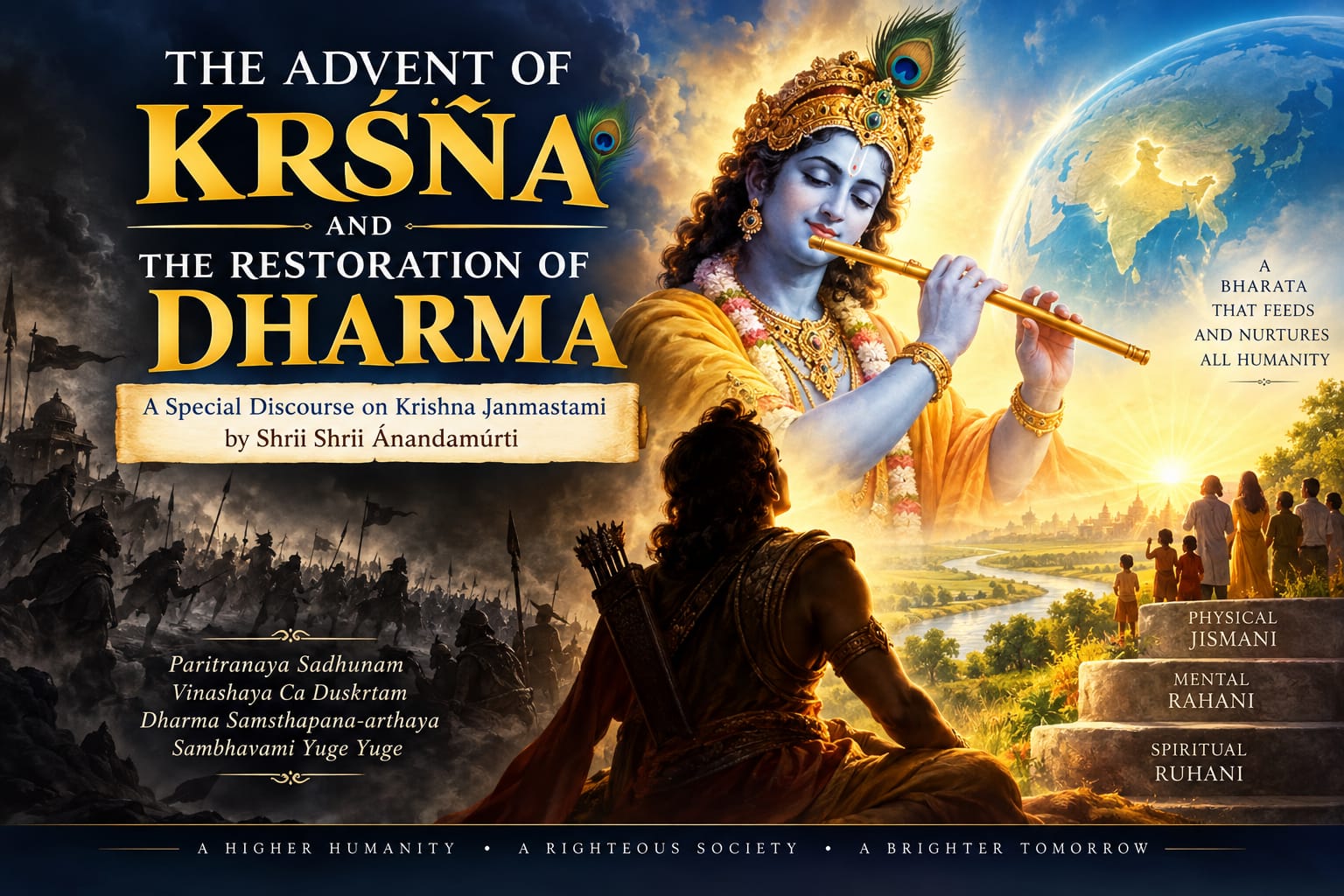
A Special Discourse on Krśńa Janmastami by Shrii Shrii Ánandamúrti
Today, we celebrate Krśńa Janmastami, a day that marks a monumental turning point in human history. On this sacred occasion, we explore the profound role that Bhagavan Krśńa played in the development and upliftment of human civilization.
While much has been spoken and written about Mahásambhúti Krśńa’s divine play, including the extensive stories of the Mahabharata, today we focus on His cosmic nucleus, eternal message: the absolute assurance of the restoration of Dharma and the elevation of human society.
To understand, we must look back 3,500 years ago, when Bhagavan Krśńa took His Avirbhava, or divine advent, on this earth. He did not arrive during a peaceful golden age. Krśńa came at an exceptionally crucial and extraordinary stage when humanity was in a deep state of discontentment. His advent was specifically designed for humanity’s upliftment — to guide a struggling society out of its despair and redirect the course of human history toward righteousness.
Abhayavanii, during this dark period, Krśńa delivered what is regarded as the greatest and highest assurance to human society. This is known as Abhayavanii — the message of absolute fearlessness and hope.
His promise is eternal: Whenever there is a dreadful degradation of Dharma, Mahásambhúti will take another advent to save the downtrodden from downfall. This assurance reminds us that humanity is never left permanently abandoned in times of moral decay.
Paritranaya Sadhunam Vinashaya Ca Duskrtam
Dharma Samsthapana-arthaya Sambhavami Yuge Yuge
Who is Bharata? In the verse of the Bhagavad Gita, Krśńa addresses Arjuna as ‘Bharata’.
But what does this word actually mean?
It is far more than just the name of a country.
Linguistically, it is derived from two Sanskrit root words:
Root verb ‘Bhr’ — which means ‘to feed’ or to supply food.
Root verb ‘tan’ — which means ‘to expand’ or to grow.
Combined with grammatical suffixes, ‘Bhara’ refers to a feeder or supplier of food, while ‘ta’ refers to helping in all-round expansion and development.
Thus, a true ‘Bharata’ is one who feeds others and nurtures their complete, multi-dimensional growth.
Krśńa expected all living persons — and especially important personalities and leaders — to shoulder the responsibility of feeding the suffering and hungry.
However, our duty does not stop at physical nourishment. We must assist others in their all-round development across three distinct realms:
1. Jismani – The Physical Body
2. Rahani – The Mental Way of Life
3. Ruhani – The Spiritual Realm
This holistic nourishment is the true essence of Bharatavarsha — a country that feeds its people and fosters their complete physical, mental, and spiritual elevation.
By Krśńa it has been said:
“Yadá yadá hi dharmasya glánirbhavati Bhárata;
Cábhyutthánamadharmasya tadátmánaḿ srjámyáham”
To understand this, we must distinguish between a battle and a war. A war is divided into multiple phases, each called a battle. In a single battle, Adharma may temporarily triumph, and Dharma may seem defeated. But we must not lose heart; while individual battles may fluctuate, Dharma is destined to win the final fight of the war.
Glani means ‘to go beyond its recognized position or stratum’ in a downward direction. When righteousness degrades and falls below its proper level, there is Glani.
Abhyutthana means ‘going above’ or rising beyond the recognized stratum. When Adharma undergoes Cabhyutthana — rising and elevating itself above its proper limits — it threatens to overwhelm the natural balance of society.
The Role of Taraka Brahma that what happens when Adharma reaches its peak?
When the degradation of society goes completely beyond the jurisdiction and physical strength of human beings, humanity is left helpless and cries out. It is at this critical juncture that the Supreme appears as Taraka Brahma.
Taraka Brahma’s role is to polarise the forces of Dharma and Adharma, separating righteousness from degradation. By drawing this clear line, Mahásambhúti intervenes to save humanity and places Dharma back into its proper, recognized position.
This is the ultimate, comforting message of Krśńa Janmastami.
