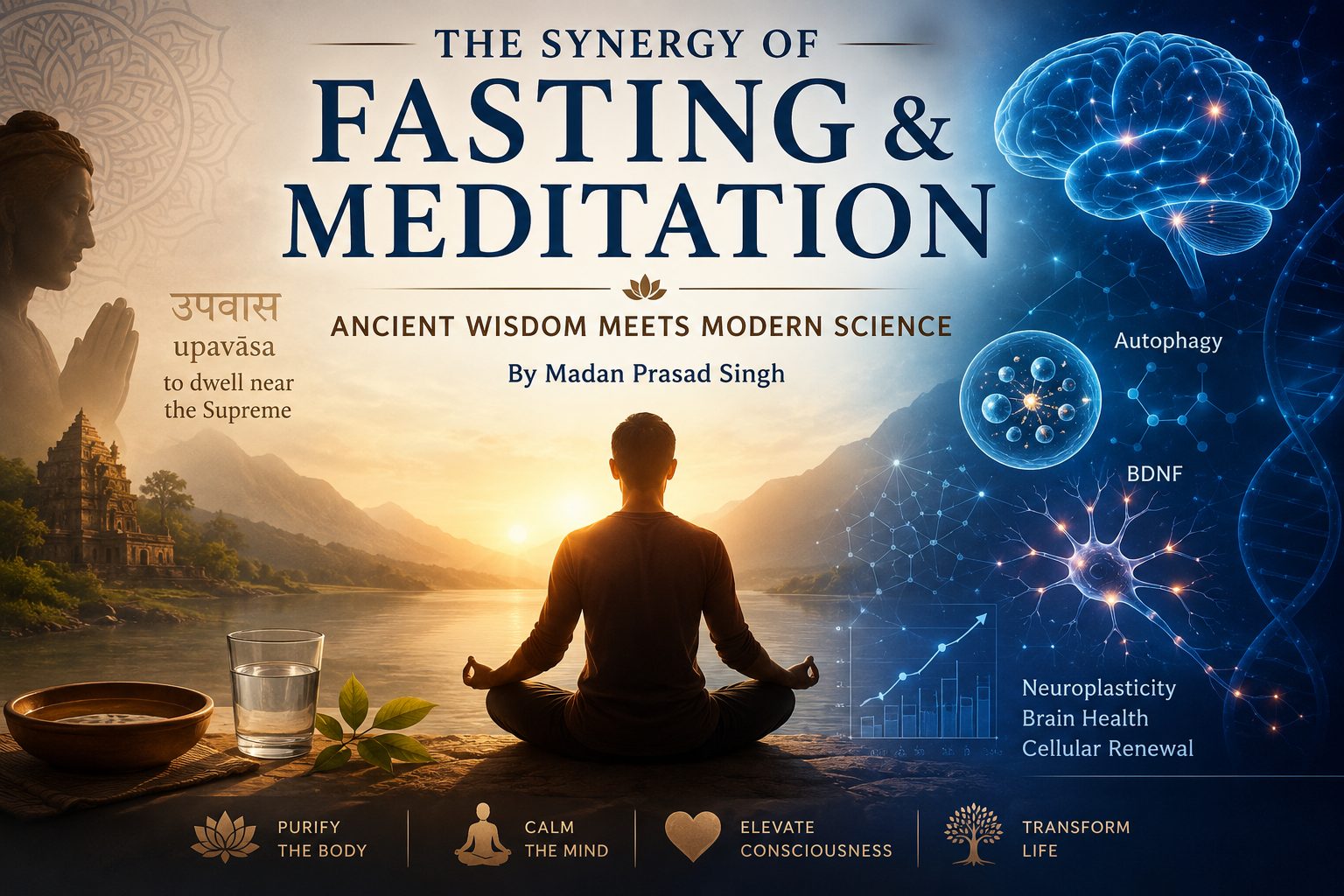
The Synergy of Fasting and Meditation: Ancient Wisdom Meets Modern Science
By Madan Prasad Singh
For thousands of years, fasting and meditation have been practiced together in spiritual traditions across the world. Yogis, monks, and sages regarded them as complementary disciplines that purified the body, sharpened the mind, and elevated consciousness. Today, advances in biology and neuroscience are revealing that many of these ancient practices have measurable physiological and psychological effects.
Within the socio-spiritual philosophy of Ananda Marga, founded by Shrii Shrii Anandamurti Ji (Prabhat Ranjan Sarkar), fasting is understood not merely as refraining from food but as a profound spiritual discipline designed to deepen one’s relationship with the Supreme Consciousness.
Shrii Shrii Anandamurti Ji explained the true meaning of upavása as follows:
“Upavása” – on these days of fasting, what are all spiritual aspirants to do? Mentally they should live near their Lord. On all other days they are to remain balanced between objective adjustment and subjective approach. On these days of fasting, however, on these days of upavása, one remains in closer proximity to the Lord than to oneʼs mundane duties. That is why these days are known as “upavása”. The word “fasting” does not represent the proper sense or proper spirit.
This interpretation shifts the emphasis from the physical act of abstaining from food to the deeper purpose of cultivating constant remembrance of the Divine. In Sanskrit, upa means “near,” and vása means “to reside.” Thus, upavása literally means “to dwell near the Supreme.” Physical fasting becomes a supporting discipline that helps the practitioner remain mentally and spiritually closer to the Divine.
Shrii Shrii Anandamurti Ji also explained the physiological significance of fasting:
The food that we take is converted, through transformation, into its final essence, called shukra. Shukra is the food of the brain. From it, the ectoplasmic particles of the unit mind are produced. If one fasts according to the system, no excess shukra will excite the lower vrttis of the mind, and the mind will be led toward the higher vrttis. Furthermore, as a result of fasting, the poisonous and unnecessary waste of the body gets destroyed and expelled. Moreover, the energy that is not expended in digesting food can be utilized for other purposes. Therefore, a fast day is an excellent time for sádhaná.
While the terminology reflects the yogic and spiritual science of Ananda Marga, modern biological research has identified several physiological mechanisms that resonate with some of these observations.
One of the most important discoveries is autophagy, the body’s natural cellular recycling process. During fasting, cells begin removing damaged proteins, dysfunctional organelles, and accumulated cellular waste, allowing healthier components to replace them. This process contributes to cellular maintenance and resilience. The molecular mechanisms underlying autophagy were elucidated by Japanese cell biologist Dr. Yoshinori Ohsumi, who received the 2016 Nobel Prize in Physiology or Medicine for this pioneering work.
Fasting also influences brain function. Research by neuroscientist Dr. Mark Mattson and others has demonstrated that fasting increases the production of brain-derived neurotrophic factor (BDNF), a protein that supports neuronal survival, learning, memory, and cognitive adaptability. Elevated BDNF levels are associated with improved brain health and greater mental resilience.
Meditation complements these biological changes. While fasting initiates internal physiological repair and conserves metabolic energy, meditation trains the mind to become calm, focused, and inwardly aware. Neuroscientific studies have shown that regular meditation enhances attention, emotional regulation, stress resilience, and neuroplasticity—the brain’s remarkable ability to reorganize itself by forming new neural connections.
Together, fasting and meditation create a powerful synergy. Fasting reduces physiological demands on the body while activating restorative processes. Meditation directs the conserved physical and mental energy toward self-awareness, concentration, and spiritual realization. In this way, each practice reinforces the benefits of the other.
Beyond physical health, these disciplines cultivate self-control, moderation, clarity, compassion, and resilience. They encourage individuals to transcend habitual patterns of thought and behavior, enabling a more balanced and purposeful life.
Although fasting offers numerous potential benefits, it should always be practiced responsibly. Extended fasting may not be suitable for everyone, including children, pregnant women, individuals with eating disorders, or those with certain medical conditions. Medical guidance is advisable before undertaking prolonged fasting.
Modern science does not claim that fasting or meditation is a universal cure. Rather, an expanding body of research suggests that, when practiced appropriately, they can support metabolic health, cognitive performance, emotional well-being, and healthy ageing.
The teachings of Shrii Shrii Anandamurti Ji present a broader perspective: the highest purpose of fasting is not simply physical purification but spiritual proximity to the Divine. Scientific research is increasingly illuminating many of the biological benefits associated with fasting and meditation, while the spiritual traditions remind us that these practices ultimately aim at inner transformation.
When the body is purified, the mind becomes clearer. When the mind is stilled through meditation, higher awareness naturally unfolds. In the harmonious union of fasting and meditation, ancient wisdom and modern science together point toward a healthier, more conscious, and spiritually enriched human life.