THE ILLUMINATION OF CONSCIOUSNESS
Diipávalii when Bábá comes Home
A compilation based on the discourses by Shrii Shrii Ánandamúrti and composition of Prabhát Saḿgiita by Shrii Prabhát Raiṋjan Sarkár – dedicated to Beloved Bábá
Edited by Ácárya Gatimayánanda Avadhúta – CTS, Sweden
The Historical root of Diipávalii as revealed in Satyabhama and Rukmini, Bábá’s Discourse, 9 October 1988, Calcutta
Diipávalii is far more than an external festival of lights; it is a profound journey of spiritual awakening.
To understand it, Bábá takes us back to Satyabhama and Rukmini, Lord Krsna’s consorts, who were always spoken of together. But they represented two different powers.
Satyabhama represents shakti, action, victory. She teaches us to fight Narakasura, the demon within and without.
Where as Rukmini represents bhakti, devotion, constitution. She teaches us to change hearts, not just win battles.
Diipávalii is both together. Light the lamp to celebrate Satyabhama’s victory, and light the lamp in the heart to follow Rukmini’s path.
“Isa mana ka’ jo andhaka’r hai usko hat’a’na’ hae. Esa’ nahin kahana’ hai ki – Ghar-ghar men Diivalii, Mere ghar men andhera’. Ghar men bhii Diivalii honii ca’hiye. Aor ye Diivalii, a’tma’ kii Diivalii.” (03 June 1990, DMC discourse: The Cult of Spirituality)
‘In each and every house there is a festival of light, yet my home is dark’, one should not say like this. Instead, there should be Diipávalii (festival of light) in the home, and it is the Diipávalii of the átman’ (festival of soul).
That is why, through our social festivals, Bábá reminds us — When the lamp is lit inside, no home can remain dark. The darkness of the átman is removed. Diipávalii is not only fireworks outside, it is the illumination of consciousness inside.
There are innumerable songs that you listen to. And there are songs that listen to you.
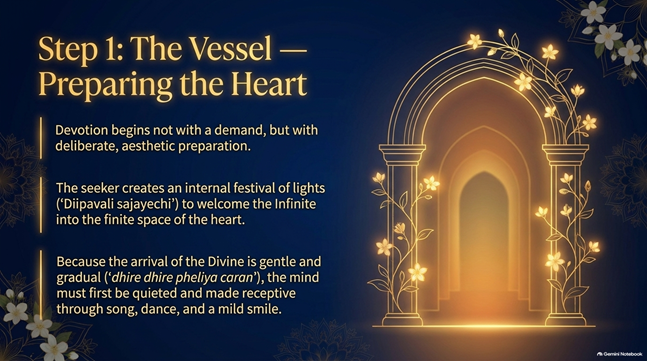
This is one of the second kind. It begins not with music, but with a preparation. A quiet, patient preparation of the heart.
As if the soul has been sweeping a small inner room for a long time, placing a flower here, lighting a lamp there, waiting for a Guest who may come at any moment. The Guest is Bábá.
The Journey inwards portrays a deep spiritual yearning to welcome Bábá’s rosy feet into one’s life. Not with grandeur, not with display, but with pure devotion and artistic expression.
The lyrics weave together the imagery of a gentle journey. A journey that is not across countries, but across the inner chambers of the heart. Step by step, the singer readies himself or herself for a sacred encounter.
This is the soul’s patient effort. To become worthy, not by perfection, but by love. To become soft enough that Grace can enter.
Love, Grace, and inner awakening emerge as the central themes. The singer invites the Bábá’s presence not into a temple of stone, but into the innermost chamber of the heart.
It is a lyrical prayer of adoration and surrender, capturing the profound beauty of connecting with the Infinite Spirit.
This inner Light that shatters illusion is what Bábá has portrayed here in this lyrics as the ultimate source of light and enlightenment.
A light that does not merely show the path, but shatters devotees illusions. His presence, the song says, cannot be captured through intellectual study. It cannot be bought with worldly status, degrees, or fame. It is revealed purely through His wee bit of Grace, to those whom BÁBÁ picks, whom HE chooses.
This festival song celebrates an entity who transcends human thought and earthly bounds, yet freely showers boundless compassion upon humanity. Bábá is not a judge sitting far away. Bábá is a liberated and awakening force that heals through unconditional love rather than rigid judgment.
That is why the song becomes a spiritual hymn of surrender. Not surrender as defeat, but surrender as coming home.
Lost, and longing to return. And then the mood shifts. The song speaks of a deep spiritual and emotional disorientation. Of one who feels utterly lost and has forgotten the way back to their true home.
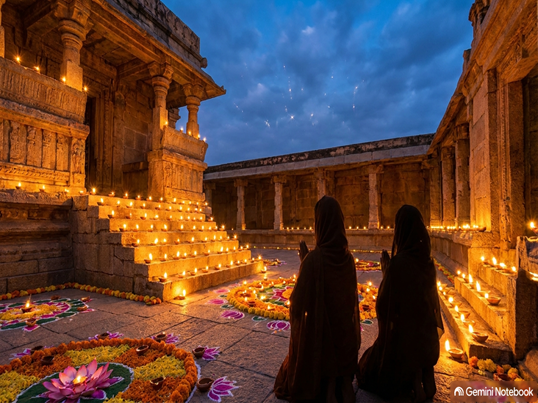
Through evocative metaphors of nature, blooming flowers in hidden groves, and a solitary journey through a vast, untamed wilderness, the lyrics Bábá illustrate a profound devotee’s yearning for divine guidance and affection.
It is the feeling of being alone in a forest at night. You know home exists, but you have forgotten the road.
So this song invokes a mood of melancholic longing, using the traditional musical reference of Deepak raga, to ask a higher presence for comfort and a clear direction.
Deepak, the raga of fire, of light in darkness, becomes the perfect voice for this cry.
A Plea for Love, in its final movement, this lyrical piece becomes a poetic plea. A plea to replace inner emptiness with unconditional love. A plea to find a path forward amidst overwhelming isolation. It does not ask for wealth. It does not ask for miracles.
It asks only for one thing:
Let me feel You near.
And that is the beauty of this composed song by Bábá. It begins with preparation, moves through adoration, passes through lostness, and ends in surrender. It is not just a song about Bábá. It is the story of every soul who has ever waited, wept, and hoped that one day, Bábá’s rosy feet would walk into the small, cleaned room of their heart, and stay forever.
Diipávalii is far more than an external festival of lights; it is a profound journey of spiritual awakening.
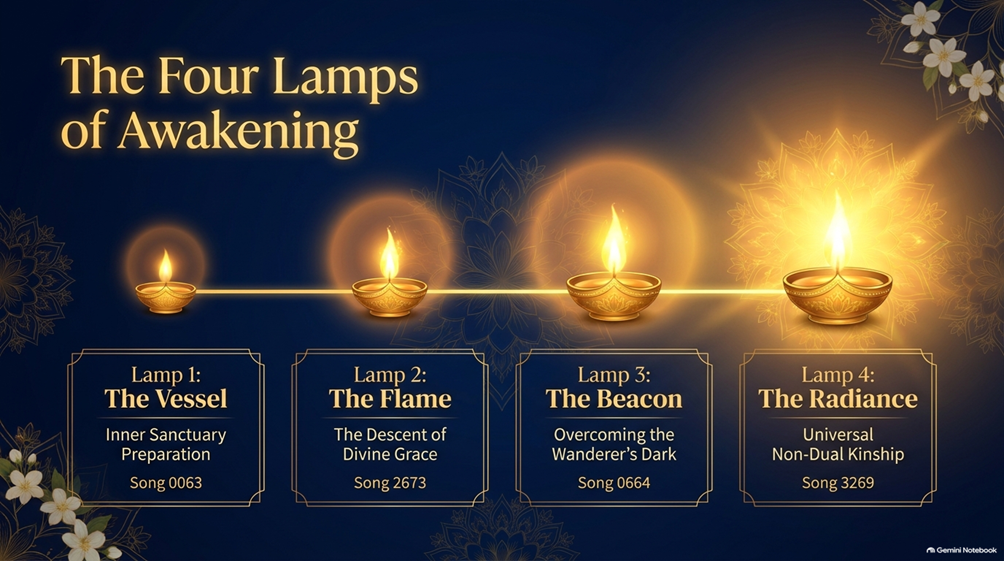
Through four sacred Bengali devotional songs, Bábá wants us to explore how ceremonial lamp lighting (Diipávalii) symbolizes the dispelling of inner ignorance, the reception of unearned divine grace, and the realization of universal kinship.
Together, these lyrics outline a complete spiritual progression from existential loss to supreme cosmic joy.
Bábá gives us how one must create sacred welcome by preparing the Inner Sanctuary, thus this devotional composition Diipávalii Song was composed (Song #0063), Diipávalii is established as an act of sacred invocation.
The seeker lovingly prepares floral offerings and lights ceremonial lamps to welcome Bábá’s presence into the core of consciousness (hrid maje).
Crucially, the festival lighting song emphasizes that even the capacity to arrange this devotional welcoming is bestowed solely through Bábá’s grace (krpa).
Upon entering the devotee’s lotus-like memory, the Supreme Lord Bábá fills the mind with divine music and dance, infusing spiritual rhythm into the realm of thought (bhavaloke chanda) and awakening captivating inner beauty.
“I have arranged flower petals and lit ceremonial lamps to welcome You… Come into the core of my heart, and within the lotus of the mind, move gently. Solely through Your grace, O Lord, have I prepared this offering to receive You. Through heart-captivating melodies and divine dance, You radiate a gentle, glowing smile.” — Song #0063 (Diipávalii Song)
In another rendering Bábá wants dispelling Illusion through His Transcendent Grace, this song “Diip Jvelecho A’lo D’helecho (Song #2673), lighting the lamp (Diip) represents the pouring forth of supreme illumination that shatters all worldly illusions (moha).
The lyrics declare that Supreme Reality is unconditioned and untethered, existing far beyond the reach of academic scholarship, intellectual debate, or worldly status and prestige (lok pratishtha). Transcending speech and mind (vakya maner agocara), our Beloved Bábá arrives solely out of unconditional love to bestow boundless, unstoppable grace (karuna) upon the sincere seeker.
“You have lit the lamp and poured forth the light; You are free, You are the sacred revelation. You have drawn us close and shattered all illusion… You cannot be known through academic intellect or worldly fame. To whomever You wish, You reveal Yourself.” — Song #2673 (Diip Jvelecho A’lo D’helecho)
In this lyrical composition Bábá wants existential wandering spiritual aspirant to play the Deepak Raga for this Diipávalii festivity and how it must be celebrated with divine light.
Thus the spiritual journey often originates in moments of existential displacement. In Háriye Gechi
Ájke Ámi (Song #0664), the soul acknowledges having strayed from its true path, captivated by the charm of wild blossoms and forgetting its eternal home (apan basa).
Floating companionless upon a shoreless ocean (akule), the wandering seeker pleads for divine direction. To dispel this inner darkness, the seeker requests the Supreme Charmer to sing a melody set to the Deepak Raga within the secret sanctuary of the mind (songopone)—using the classical melody of fire and light as an internal beacon of spiritual awakening.
“I am lost today; please show me the path. I have forgotten my true home; fill me with Your divine love… In the secret sanctuary of my mind,
sing a melody set to the Deepak Raga. Companionless upon this shoreless ocean, show me the true direction of my destination.” — Song #0664 (Háriye Gechi Ájke Ámi)
This Universal Kinship has outplayed here the Cosmic Joy and Non-Duality (Ánanda Liila) in this philosophical culmination of Diipávalii which is expressed in Diip Jele Ja’i Khushiite Bhara’i (Song #3269).
Lighting the lamp is transformed into a cosmic vow to fill the entire world with joy and eradicate all sorrow and tears (ashrushikta akhi). Realizing non-duality, the singer proclaims an eternal bond with all creation from time immemorial (onadi kaler), asserting that no one is a stranger (keu por na apon je sobai). Immersed in divine melodies and floating in a garland of cosmic love (pritir mala), all beings are invited to participate in this harmonious play of divine bliss (anander liila).
“I light the lamp and fill the world with joy—I belong to you all. No one is a stranger here; everyone is my very own. From time immemorial, I am yours… Do not stay at a distance, and do not misunderstand me in this cosmic play of joy.” — Song #3269 (Diip Jele Ja’i Khushiite Bhara’i)
