edited and complied by Ácárya Gatimayánanda Avadhúta (CTS, Sweden)
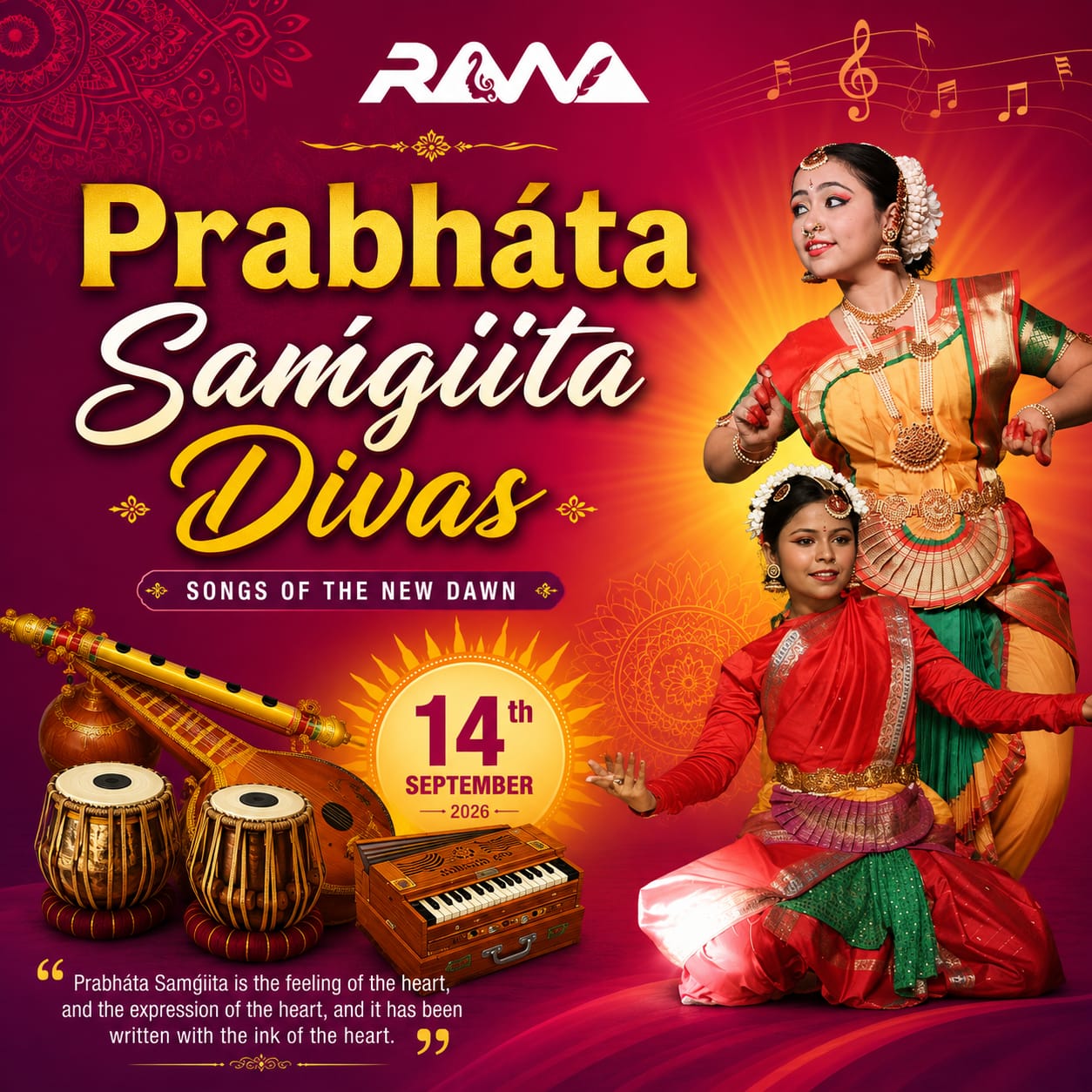
“The feeling of the heart… written with the ink of the heart.”
— Shrii Prabhát Rainjan SarkárÁnanda Vánií Samgraha
“All the beings of this universe are the kith and kin of one another. No one is despicable. All are equally respectable and entitled to equal love and affection. No problem is to be ignored as an individual or group affair. Every problem is to be considered as the collective problem of universal humanity and is to be resolved collectively, and resolved it must be.
Let it be the vocal panorama of the newer world of today – the continuous musical notes behind the movement of Neo-Humanism.”
— Ánanda Púrnimá, 1982
On September 14, 1982, in Deogarh, the first rays of a new musical dawn broke. On that day, Shrii Prabhát Rainjan Sarkár, lovingly called Bábá, composed the first song of Prabháta Samgiita, subtitled “Rays of Crimson Dawn in Musical Symphony.”
What began as a single composition blossomed into a universe of 5,018 songs created over 8 years, 1 month and 7 days (2,957 days), concluding with Song No. 5018 on October 20, 1990, in Tiljala, Kolkata.
This September 14, 2026, we celebrate not just the 44th Prabháta Samgiita Jayantii (birth anniversary), but a phenomenon that is globally unique in the history of music.
No composer in known history has created such a vast original body of work — both lyrics and tune — with such speed and precision.
The journey started in Deogarh and travelled through Ranchi, Anandanagar, and even hospitals, cars, field walks and trains. The vast majority were given in Kolkata — 3,749 songs at Madhu Málainca and 602 at Madhu Koraka.
On November 20, 1984, Bábá created world history by composing 15 songs in a single day (No. 2101–2115).
Each song was dictated to a three-person “Ga’n Party”. Bábá would first hum the melody twice and seek approval, then sing the lyrics and tune together at lightning speed while attendants transcribed them.
Bábá made them sing it back until it was rendered perfectly accurate, and often explained profound philosophical details connected to the song.
Having already established the philosophical framework of His mission, Bábá now gave it in musical form so that everyone could internalize it easily.
Formally spelled Prabhát Samgiita, it signifies the dawn of a new era that dispels static sensory pleasure and ushers in transcendental devotion.
Bábá defined true Samgiita as a synthesis of Giita-Vádya-Nrtya (song, instrumental play and dance), built on four pillars: Bháva (idea), Chanda (rhythm), Sura (melody) and Bhásá (lyrics).
“Phonetics depends on the science of breath, on inhalation and exhalation. Also on the basis of the science of breath, Shiva invested the world of rhythm with mudrá.”
It moves from Nandan Vijiinána (aesthetic science) to Mohan Vijiinána (supra-aesthetic science) — enabling the practitioner to merge into Divine Enchantment (Mohana).
Its purpose was clear: to establish a brand-new Gharáná — a new musical school with its own identity, and to serve as a spiritual tool for Sádhaná, vibrating with devotion and deepening love for the Supreme Loving Father.
The Science of Uniqueness: What Makes It Globally Different
Its linguistic mastery and lyrical craft are unparalleled. While predominantly in Bengali — chosen for its high proportion of Samskrta root words allowing subtle expression — the collection spans eight languages: Bengali, Samskrta (9 songs), English (3 songs: No. 68, 5008, 5009), Hindi/Urdu (∼20 songs), Maithili, Angika and Magahi. Its sweetness lies in the science of blending Komala-svara (soft consonants) with Kathor Dhvani (hard sounds). Bábá even introduced Pluta-svara (extra-long vowels) for Kheyal-style rendering.
Yet, Bábá assured that learning Bengali is not mandatory to reap its spiritual and therapeutic benefits.
This musical diversity is an ocean of all genres in one. Prabháta Samgiita is an ocean containing all rivers of musical Rágas. It incorporates 6 primary Rágas and 36 Ráginiis, including the revival of ancient modes like Diipak Rága from Lord Shiva’s era, plus many unnamed new Rágas created by Bábá Himself. Bábá gave genres for most songs, such as Dhrupadi, Kheyal, Tappa, Thumri, Ghazal, Hava-Ghazal, Qawwali, Baul, Jhumur, Bhatiyali and even international melodies — Scandinavian, Israeli, Chinese, Swedish and Persian.
Bábá explained the evolution of instruments while rendering this lyrical symphony. The Flute (Banshii) from hollow bamboo was the first natural instrument; Ektárá was the oldest stringed instrument, which Lord Shiva perfected into the Viiná (Shivakona) to align with the Sura-Saptaka (seven notes).Bábá traced the Tabla to Mrdanga in India, Sitar to Persia, and Violin to Italy. He taught that tuning strings teaches Majjhimá Márga — the Middle Path — neither too slack nor too strained to breaking point. Bábá distinguished a Samgiitajinána (vocal virtuoso) from a Shilpii (instrumental artist displaying hand dexterity).
Over half a century later, on 6th October 1985, during a discourse on linguistics in Calcutta, Shrii P. R. Sarkár recounted an experience which gave an insight into the pastimes of His early days in Jamalpur: “At that time I used to walk in the hills to the east of Jamalpur nearly every day. After dark, these terrifying places became young Shrii Prabhát Rainjan Sarkár’s private refuge — a vast expanse of desolation far from the hustle and bustle of the world where no one would disturb Him. Often when people returned home around dusk, they saw Him walking towards the hill. At times He would carry a flute and spend hours experimenting with different tunes or playing the Sindhu-Bhairavii Rága composed by Lord Shiva 7,000 years ago, which had since become defunct.”
At other times, He played Meghamallár (a Rága capable of attracting clouds and bringing rain) or Multánii Vasanta. He spent several evenings alone there experimenting with various Rágas and blending them on His flute.Sometimes His friend, Prasenjit, would accompany Him, bringing his Esraj. Nobody had ever seen Shrii Prabhát Rainjan Sarkár learning the flute or any other musical instrument. So it was generally believed that, like everything else, He acquired vast knowledge of music from a mystical source.
In His home, an academic atmosphere prevailed. Music was also encouraged, along with reading, discussions and studies. Mother Abharani was a good singer. Shrii Prabhát Rainjan Sarkár’s elder sister, Hiiraprabhá, also learned the songs of Rabindranath, Nazrul, Atul Prasad, Dijendra Lal and Rajani Kanta. Pandit Hiyalal Jha gave her Sitar and Violin lessons. Shrii Prabhát Rainjan Sarkár used to sit beside His elder sister listening intently. During the summer holidays, Shrii Lakshmi Narayan would take the family to Bamunpara for about a month.
Some sources have told us that Bábá used to teach dance at that time.
Beloved Bábá knew each culture has its unique traditions, styles and techniques, shaped by history, geography and social context. From the intricate footwork of Indian classical dance to the energetic rhythms of African drumming, each tradition has its own beauty and significance — like Ajay Valley, Italy, Spain, Portugal, Bengal, Malraki Valley, Albania, Belgium, China, Kangasvati, Damodar, 1,500-year-old Buddhist Tantra, Giiti Roy, Suvarnarekha Valley, Scandinavia, Middle East, Europe, Ganga Valley, Aosta Valley, 2,000-year-old Punjabi, Kashmir, Persian, Karnataka and South India, with the melodic Gharanas of Ghazal, Qawwali, from Rága Diipaka from the time of Shiva, Shivaranjani, Jaunpuri, Tappa, Tintal and Bageshrii Gharana, etc., which can be played in Prabháta Samgiita melodies.
The Impact of Song, Dance and Instrumental Percussion
All this, Prabháta Samgiita has a profound impact on our lives, influencing our characteristic bearing of sentiments, both devotional and emotional, thoughts and behaviours. It has the power to:
Evoke strong emotions and create a sense of connection
Preserve cultural heritage and traditions
Provide a means of self-expression and creativity
Bring people together and foster community
Influence our mood, energy and well-being in the all-round development of physical, mental and spiritual spheres.
The spiritual and healing essence of these songs expresses every shade of the devotee’s heart — from intense Viraha (separation) to Madhur Bháva (divine union), along with universalism, social awareness and Neohumanist love for nature. Bábá introduced the concept of Ajána Pathik — the Unknown Traveller, representing Táraka Brahma playing hide-and-seek with creation.
This is more than devotion; it is therapy. Rágas stimulate nerve fibres and vital energy, offering help for conditions like hysteria, melancholia, gout, epilepsy and nervous exhaustion.
Gandharva Microvita assist in recovering lost melodies and awakening subtle devotion. Five songs (No. 154, 158, 159, 162, 163) were designated as compulsory for collective spiritual functions.
Scholarly musicians like Prof. Ramaranjan Mukherji and Dr. Subhas Sarkar, to whom the work is dedicated along with maestros Ramnidhi Gupta (Nidhi Babu) and Ustad Alauddin Khan, have highlighted its role in rescuing the spiritual supra-sensuous from material degradation.
For every moment of life, Prabháta Samgiita is not only for meditation. It contains specific songs for every social function and various uncountable themes — from Brahma to a blade of grass — such as weddings (No. 58), baby naming (No. 59), house entry (No. 137), tree planting (No. 136), birthdays and seasonal festivals. Kiirtan itself functions as Lalita Dance — a fine art (Lalitakalá/Cárukalá) that expands the mind.
To popularize it, Bábá structured cultural forums such as RAWA, Spandanik, Chándosik, Nándosik and Surasaptak.
Official Release Note:
44th Prabháta Samgiita Divas — Inauguration of the Prabháta Samgiita Gharáná AI Platform
On the spectrum of this new era, our Central Administration is proud to unveil a new vista in the form of an Artificial Intelligence App, released on the auspicious 44th Anniversary of the Inauguration of the Prabháta Samgiita Gharáná.
This intelligent platform is designed to offer website visitors a vast array of foresight and deeper insight into the songs. It provides extensive resources — including audio recordings, translated lyrics and musical notations — to help seekers engage deeply with the collection’s devotional themes. By categorising the songs according to language and varied themes, the site ensures easy navigation through these expressions of spiritual bliss.
In addition, the Ánanda Márga archive provides educational materials on linguistics and musicology, along with unique live recordings that capture the historical performances of these pieces in Bábá’s presence. Ultimately, this resource aims to help individuals transcend mundane existence through the emotional and aesthetic power of sacred song.
Today, its preservation and presentation are spearheaded by Prabháta Samgiita AI, under the Ánanda Márga Web Team led by Dewasheesh Rana, along with the Deepeshvara PR team. This team is releasing the new website and App with the complete archive of lyrics, translations, notations (Svaralipi), and almost all 5,018 MP3s plus historical live recordings.
The Prabháta Samgiita AI App features:
Daily Inspiration for spiritual reflection
Discovery of Ánanda Márga activities along with daily news
Mood Synchronisation, to explore your inner thoughts and emotional states
Interactive Learning, to thoroughly explore each Prabháta Samgiita through quizzes, melody analysis and other musical dimensions.
This entire endeavour has been subjectively synchronized through the selfless efforts of various devotees who have dedicatedly provided transliteration and profoundly rendered the lyrics into English. This legacy is now cloned and elevated through AI on our official portal: www.prabhatasamgiita.net
On this Prabháta Samgiita Divas, 2026, we do not just listen to music. Shrii Prabhat Ranjan Sarkar (Bábá) manifested Prabháta Samgiita to establish a brand-new Gharáná with its own distinct musical identity.
It was Bábá’s direct instruction and guidance, because it was an entirely new musical school rather than an existing tradition. Singers could not simply rely on conventional training. Complex classical compositions frequently required Bábá’s direct guidance, personal demonstration and repeated corrections to ensure the songs captured the authentic refinement and rendering of this new Gharáná.
Today, we are crossing the threshold to enter a new Gharana, a new dawn, where Oriental mudrá musicology meets Occidental rhythmology, where a song is Sádhaná, and where 5,018 flowers bloom from one heart to guide humanity from Nandan (Aesthetic) to Mohan (Supra-aesthetic).
Bábá Nám Kevalam.
Prabháta Samgiita Kii Jai!
Parama Pitá Bábá Kii Jai!
