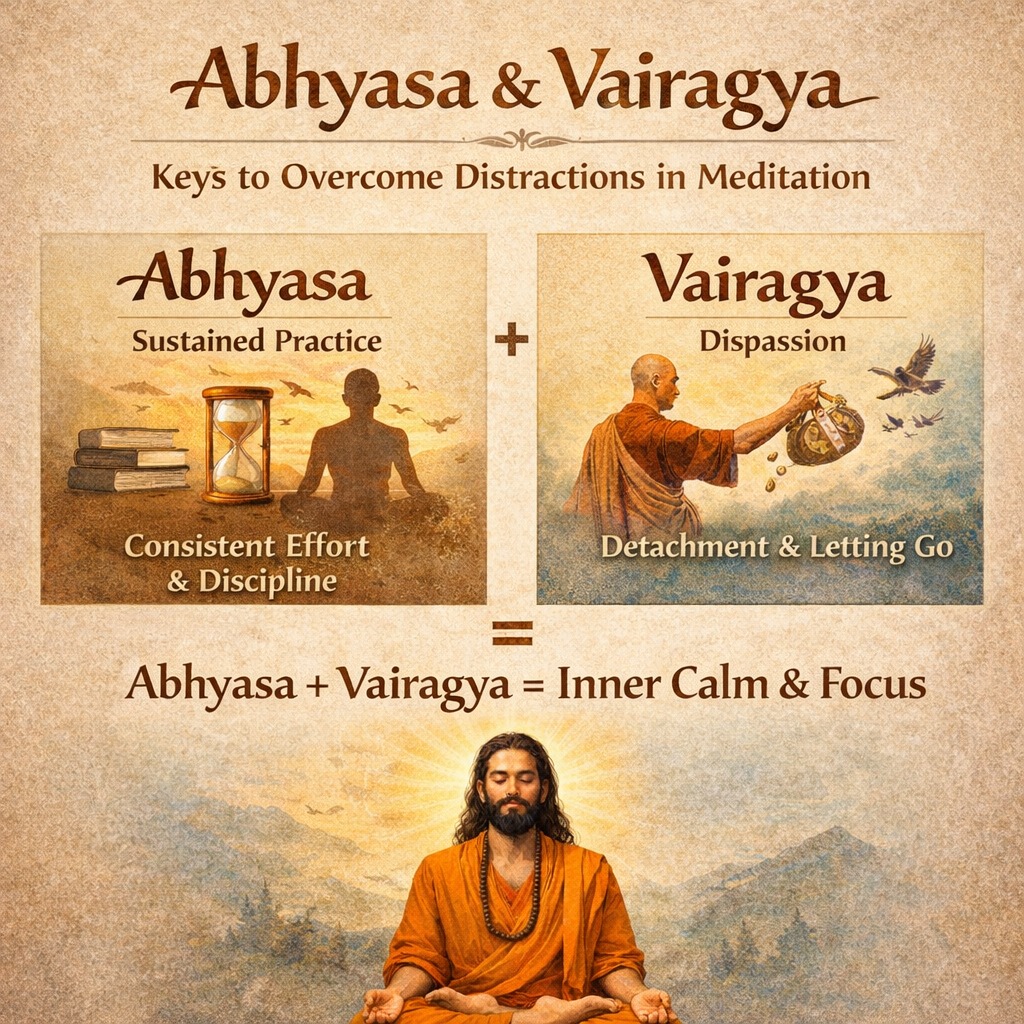
Every Sadhaka at certain point of his spiritual journey laments that he is unable to control the distractions of his mind despite his best efforts. He feels that the long hours of his sitting have landed him nowhere. In Bhagavad Giita, Arjuna laments:
Cancalam hi manah Krishna pramathi balavad dridham tasyaham nigraham manye vayor iva su-dushkaram
That is, the mind is restless, obstinate and very strong, O Krishna, and to control it, I think, is more difficult than controlling the wind. It is the case not only with Arjuna but with every Sadhaka. The distracted and fickle mind is always turbulent and creates upheavals for a Sadhaka.
The vacillations of the mind have been compared with a drunken monkey stung by a scorpion (Markatasya surapanam tato vrischika damshanam) in our scriptures. Many a time a spiritual aspirant wastes his time despite his long sitting in meditation as one or the other thought keeps bothering him. Replacing the worldly thoughts with the thoughts of God in his subconscious mind becomes a challenge. Then how to overcome this turbulence and achieve concentration in meditation? After all, Dhyana has to be like an unbroken or incessant flow (Tatra pratyaya ekatanata Dhyanam) for success. It ought to be like a smooth and continuous flow of oil (Taila-dharavat).
Lord Krishna suggests the following two remedies to tame the raging mind in Giita:
Asamśayam mahabaho mano durnigraham calam Abhyasena tu kaunteya vairagyena ca grhyate
That is “Arjuna undoubtedly, the mind is very elusive and difficult to control, but it can be controlled by sustained practice(abhyasa) and dispassion(vairagya).
By saying “Abhyasa vairagyabhyam tan nirodhah”, even Patanjali also endorses the same in his Yoga sutra. Patanjali emphasises the effort to be consistent, dedicated, prolonged and repeated one to achieve stillness. Vaeragya teaches us to be free from desire and aversion, helps us to give up things with impermanent nature.
But none of these can be achieved in a single day and there are also no shortcut methods to achieve it. Hence, Patanjali said that
“Sa tu diirgha kala nairantarya satkara sevito drudha bhumihi”
“This practice is firmly grounded only after it has been cultivated for a prolonged period, uninterruptedly and with an earnest devotion.”
However, one has to remember here that Abhyasa and Vaeragya are helpful only in overcoming the mental distractions, but they seldom help in the case of lack of concentration that arises due to health conditions such as thyroid problems, anaemia, chronic fatigue syndrome, migraines, hormonal changes, side effects of medication etc. These health conditions will lead to cognitive problems resulting in poor focus on the object of ideation. In such cases, one needs to consult a doctor.
