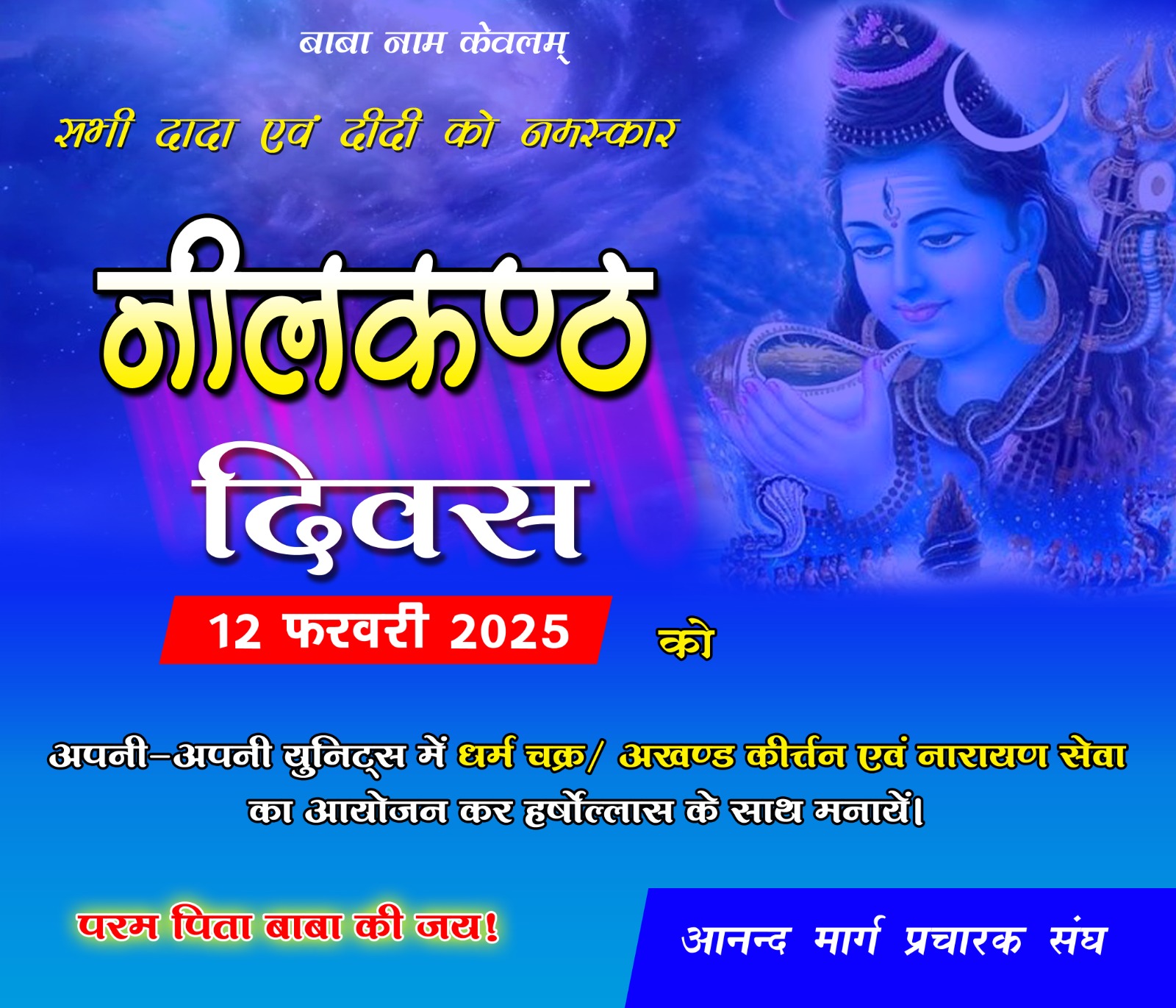
“From Poison to Nectar: Bábá’s Transformative Response” & “Bábá’s Exemplar of Virtue into a day of active service and sentient protest”
Ácárya Gatimayánanda Avadhúta—CTS, GBTC
The term Niilakantha is a traditional Sanskrit name for Lord Shiva, meaning “The Blue-Throated One.” It originates from the mythological event where Shiva drank the poison (Halahala) that emerged from the churning of the ocean to save the universe, which turned His throat blue.
Spiritual Lessons: The blue throat serves as a powerful metaphor for handling life’s challenges. Just as Shiva held the poison in his throat, individuals are encouraged to manage their own negative emotions, stresses, and difficulties without letting them overwhelm their true nature.
- Environmental Symbolism: In contemporary times, the symbolism of Shiva drinking the poison is sometimes interpreted as a reflection on environmental issues, semipolitical wars, all-round degeneration, social injustice is the principal one. Just as Shiva absorbed the poison to save the world, there is a need for humanity to take responsibility for the environmental “poisons” we create, such as pollution and climate change.
- Meditation and Yoga: In the practice of yoga, the symbolism of the blue throat is often associated with the Vishuddha Chakra, or the throat chakra. This chakra is believed to govern communication and expression, and its purification is essential for spiritual growth. The blue color is often associated with this chakra, linking it directly to Shiva’s symbolism.
By naming the day “Niilakantha Divas,” Ánanda Márga followers are drawing a parallel between Bábá surviving the poisoning and the Shiva’s who consumes the world’s “poison” to protect others, though they specifically focus on Bábá’s instruction to return that “poison” with the “nectar” of service.
Instead of fasting, followers practice sentient anger against injustice. They counter malice with nectar by feeding the needy, proving that righteousness overcomes evil through service.
Rather than observing the occasion with fasting or sorrow, Bábá instructs His followers to manifest sentient anger by actively opposing injustice while responding to malice with benevolence.
The core ritual of the day is to counteract poison with nectar by providing the highest quality food to those in need, ensuring that even those without personal means participate through collective efforts.
Ultimately, the commemoration defines the day as a triumph of spirit over persecution, urging devotees to transform a historical act of cruelty into a widespread practice of generosity and social righteousness.
Niilakantha Divas commemorates the 1973 poisoning of Shrii Shrii Ánandamúrti in prison while Bábá was held in Bankipur Central Jail.
On the night of 12 February 1973, at approximately 11:30 pm or midnight, Bábá was administered poison in the form of a capsule.
The following morning, witnesses found Bábá lying on His bed, unable to move or speak. His eyes were red and watering profusely, and his brain and nervous system were not functioning properly.
While the authorities initially suppressed the incident, medical doctors—including Margi doctors—confirmed that these were clear physiological reactions to poisoning.
This event describes it as a conspiracy by the Central Investigation under then present government to eliminate Bábá.
The Central Investigation played an amidship and mastermind role in the poisoning of Shrii Shrii Anandamurti (Bábá) on 12 February 1973.
Hatching the Conspiracy to poison Bábá in Bankipur Central Jail was “hatched by some unknown central agency”. It was a Long-term Intent that the central agency “since very beginning” trying to “finish Bábá from this world”.
The poisoning incident is presented as a peak in their ongoing efforts to eliminate Bábá.
Government Collaboration and Suppression was that the Central Agency actions were linked to the then central government, which reportedly suppressed the incident.
When Bábá and the followers demanded a judicial inquiry to uncover the “black hands working from behind the curtain” and identify those responsible for the “nefarious work,” the government refused to grant it.
This refusal to investigate the central agency’s alleged role and the government’s suppression of the facts were the primary factors that compelled Bábá to begin His protest fast, which lasted over five years, 4 months and 1 day.
Despite writing several letters to the President of India to expose those working “behind the curtain,” the lack of legal recourse or official transparency led to a period of intense agitation where these acts of self-immolation occurred.
Self-immolation was undertaken by “Dadas and Didis” who were distressed by the government’s suppression of the truth as part of a wider agitation following the poisoning of Shrii Shrii Ánandamúrti (Bábá).
The unofficial Chakraborty Commission was established to investigate the events surrounding the night of 12 February 1973, after the government refused to institute a formal judicial inquiry into the matter.
The primary finding of the commission was a definitive confirmation that Shrii Shrii Ánandamúrti (Bábá) had indeed been administered poison while being held in Bankipur Central Jail.
The fast lasted for a total duration of five years, four months, and one day.
It provides the specific start and end dates and the exact duration of the fast, that it focus primarily on the 12 February 1979 discourse in Patna where Bábá clarified how followers should commemorate the date of His poisoning, rather than detailing the specific legal or political circumstances that led to the fast’s conclusion in August 1978.
The general history indicates that the conclusion of the fast coincided with Bábá’s release from prison after the charges against Bábá were overturned; however, it highlight the 1 August 1978 date as the point at which Bábá ended His long-term protest.
A clear timeline and the physical circumstances surrounding the beginning of the five-year fast, though we are not able to offer a granular hour-by-hour account of His daily routine.
The fast was not a voluntary spiritual practice but a compelled protest against the refusal of the then Central government to institute a judicial inquiry into His poisoning.
Despite the “nefarious work” of the Central investigating Agency, Bábá maintained this fast as a way to demand judicial proof.
Bábá’s specific daily activities, such as His liquid intake, sleep patterns, or how Bábá managed His spiritual or administrative duties from within the jail during those five years.
Bábá consumed only a small amount of liquid, such as curd water or lemon water, to sustain His body, so here the philosophical shift that occurred after the fast ended, where Bábá instructed that such periods should not be commemorated with personal fasting (which Bábá termed “tamasic”), but with “Amrit”—the act of feeding others and raising a sentient voice against injustice.
Transforming the Response through Niilakantha Divas to manage the long-term memory of the injustice, the Ánanda Márga Central decided to commemorate the date of the poisoning (12 February) as Niilakantha Divas. Over time, their response evolved from “tamasic” actions like personal fasting to a more constructive form of protest.
But Bábá instructed them to raise a “loud voice” against misconduct (anacara) and the “sinners” involved, rather than suffering in silence. Answering “Vish” (Poison) with “Amrit” (Nectar).
Instead of responding with bitterness or hunger, the Ánanda Márga cadres both family members and Whole timer Sannayasin was told to respond in a “subtler way” by performing acts of service. This involved feeding the needy the best possible food as a sentient reply to the poison that had been administered to Bábá.
By establishing their own commemorative traditions and focusing on social service, the community managed the absence of official justice by turning the event into a symbol of recoil and righteous action.
Shrii Shrii Anandamurti (Bábá) described the response of “Amrit” (nectar) to “Vish” (poison) as a “subtler way” of answering injustice. Instead of reacting with “tamasic” (static) or “rajasic” (mutative) anger, Bábá instructed His followers to use “sattvika krodha” (sentient anger) to counter the “nefarious work” of His poisoners.
Bábá explicitly questioned why followers would choose to fast on this day, stating it was not a day for hunger but a day to voice opposition against misconduct. Bábá told His followers to “eat well” and use their energy to protest against “anacara” (misconduct). To answer the “poison” Bábá was given, Bábá directed that every follower or family should, according to their capacity, feed the “best possible food” to at least one needy or deserving person.
If a family had five members, they were encouraged to feed at least five (or more) people. This instruction applied to everyone, including Avadhuta’s, Ácárya’s, and full-time workers who have no personal property.
Bábá specified that they should collect alms or raise funds specifically to buy food and feed others, ensuring the “Amrit” of service was distributed regardless of one’s own financial status. The essence of the “Amrit” response was to provide a positive, sentient alternative to the harmful act of poisoning.
While the “Vish” represented the conspiracy to “finish Bábá from this world,” the “Amrit” represented the spiritual Ánanda Márga members commitment to service and righteousness.
By giving “Amrit” in response to “Vish,” Bábá transformed a day of tragedy into a day of active service and sentient protest, where the reply to a grave sin was the performance of a virtuous deed.
ÁNANDA VÁŃII – History bears testimony that whenever a person states the absolute truth in any sphere of life, whether it be spiritual, social, economic or otherwise; sought clarification of doubts or protested against injustice and wrongs, the evil forces forthwith plotted against the person, administered poison, slandered and assaulted that person with rage, misused authority and mercilessly dealt blow after blow; but the blows boomeranged and ultimately the evil forces were annihilated by those very blows. Remember, by an unalterable decree of history, the evil forces are destined to meet their final doom. – 1 January 1974